CLIMB flagship — assembled working draft (with slots)
Assembled and re-synced 2026-08-26 with the completed intervention readouts from
paper/flagship/S*.md (single source of truth: the section files; this file is generated by
concatenating them and must be re-synced after every section edit).
Title NOT final — five candidates under review in paper/00_outline.md. Status labels:
sealed ✓ / sealed ✗ (kept) / measured / exploratory / pending 🕐. Every number's artifact path:
paper/RESULTS_LOG.md. N3, E-HYG, P-SIGN, soft FGAS, and N7 are reported with their sealed misses
intact; the segment-v2 pilot is a failed manipulation rather than an adaptive-allocation null, and
E3 remains an explicit slot. Figures F1–F7 and their
generating scripts: paper/00_outline.md §Figures. Red-team audit: paper/RED_TEAM.md.
1. Introduction
Generalist humanoid motion tracking has converged on a recipe: retarget a large mocap corpus to the robot, train a tracking policy over the whole bank in massively parallel simulation, and steer training with a curriculum that samples harder motions more often. The recipe scales — trackers now follow tens of thousands of clips — and each of its stages trusts the one before it: the curriculum trusts that failure means hard, the trainer trusts that the references are achievable, and the benchmark trusts that averaged survival measures skill. This paper is an end-to-end audit of that chain on a Unitree G1, and its central finding is that the chain's core quantity — per-clip difficulty — conflates three different things that no stage of the standard pipeline can tell apart:
difficulty = feasibility × support × intrinsic.
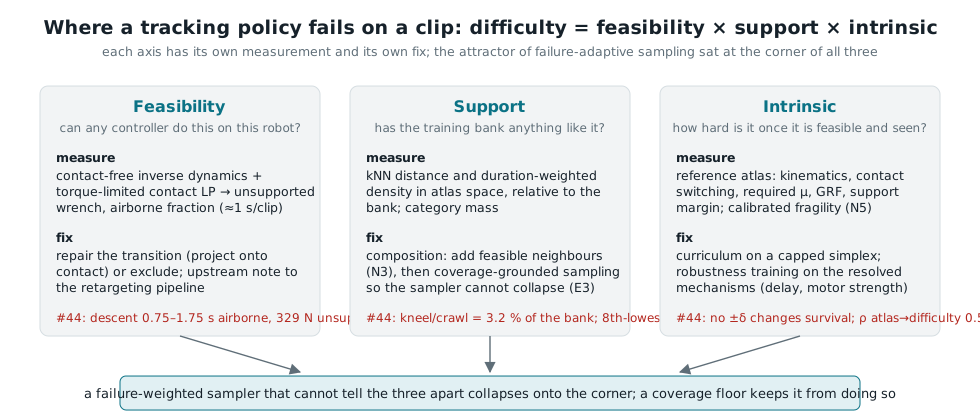
A clip can fail because no controller could track it on this robot (feasibility: the retargeted reference demands forces that no available contact can supply); because the training bank contains nothing like it (support); or because it is genuinely demanding (intrinsic: speed, contact switching, friction). Each factor has its own measurement — a per-frame contact-feasibility screen, a bank-relative density, a reference atlas — and its own fix: repair or exclusion, bank composition, and curriculum or robustness training. A failure-weighted sampler that cannot distinguish them collapses onto the corner where all three coincide.
We found that corner empirically. A failure-adaptive sampler of the family used by current open-source trackers concentrated 87–89 % of its exposure on a single kneel-and-crawl clip in three of three seeds — the same clip every time — and lost to uniform sampling on held-out survival (0.780 vs 0.810, 3/3 seeds). Part of the cause is a bug with reach: the sampler's advertised uniform-mixing floor is added to counts, so the true floor is ε/(Σq+ε) < 1 % and shrinks with environment count; we derive this, file it upstream, and repair it with a one-line normalise-then-mix that provably floors exposure (§3–4). But the deeper cause took three instruments to find. A pre-registered physics-fragility gate — 1,440 paired counterfactual worlds across action delay, motor strength, friction, contact stiffness, contact model, and center of mass — failed its own sealed criteria: nothing moved the clip's survival (§5). What finally explained it was a per-frame feasibility test of the reference itself: for a full second of the retargeted descent, no part of the robot is within 6 cm of the floor while the pelvis drops 0.35 m — roughly the robot's entire weight (~329 N) has nothing to push on. The clip is impossible, its feasible kneeling core is absent from the bank (3.2 % of training duration), and the sampler weighted it precisely because failure was guaranteed.
Screening the full 10,705-clip bank (~1 CPU-second per clip) shows this is not an anecdote: 22.8 % of clips are dynamically infeasible for more than 10 % of their frames, ranging from 0.1 % to 100 % across source datasets under a single retargeting pipeline — a corpus-and-pipeline property, not a difficulty gradient — and contaminating 29 of our own 100 evaluation clips (§6). The complement matters as much as the number, and we state it before anyone infers a rate for retargeted banks in general: an independently re-implemented screen over the 4,950-clip BONES-SEED bank that trains SONIC returns 0.14 %, 160× lower, on a pre-registered test whose pre-committed consequence (descoping a planned training ablation there) was taken [measured; §6]. Prevalence is a property of a particular corpus-and-pipeline pairing; it has to be measured per corpus, and at ≤ 1 CPU-second per clip it can be, as a standing release gate. Adding feasibility features to a reference-difficulty model produces the first cross-policy transfer gain that survives a permutation baseline (Spearman 0.567 → 0.609, p = 0.01): feasibility is the component of difficulty that belongs to the clip rather than to any particular training run (§7).
The audit itself required two methodological instruments that we release with the paper. First, a
dual-stack conformance protocol: before any physics claim, the same engine (MuJoCo Warp 3.11.0)
was reached through a second integration stack — Newton (commit 7bb6d02d) via its SolverMuJoCo
path, against mjlab v1.6.0 driving it directly, with classic MuJoCo 3.11.0 (C) as a third referee —
and driven to per-substep agreement (|Δq̇| ≤ 3×10⁻⁵)
— which surfaced four silent integration errors whose combined effect, a 40-point survival fork,
we had initially misread as a finding and here explicitly withdraw (§5.1, Appendix A1). Second, a
calibrated sensitivity statistic: paired-trajectory differences are chaos-dominated at the
millimetre scale within seconds, and only signed replicate-mean effects measured against a
published identical-physics floor resolve mechanism effects (6–14 mm, replicated across seeds at
r = 0.92; §9).
Because this project's history is a catalogue of plausible findings that dissolved under audit — a transfer gap that was an observation bug, a curriculum deficit that was a sampler bug, a "hardest clip" that was a data bug — every interpretive claim in this paper was hash-sealed before its numbers existed, and the full ledger, including failed gates, a withdrawn verdict, and nulls, is a first-class exhibit. N3 now supplies a mixed intervention result — its targeted-composition endpoints pass, but an adaptive-arm regression triggers the frozen interpretation stop — while E-HYG finds no benefit from blunt clip pruning. Support moderation at scale remains sealed and pending, with named clips predicted to get worse. We retain all of these outcomes without reframing; the decomposition, screen, repair, and audit discipline do not depend on every intervention being positive.
Contributions. (1) A mechanism-level diagnosis of failure-adaptive curriculum collapse in
humanoid tracking, including the non-floor derivation, with upstream fixes filed — and the
exposure accounting that quantifies the cost: the shipped sampler concentrates a mean 48.8 % of
all clip draws on whichever single clip is currently winning (peak 87–89 %), and at least 21.9 %
of them on the impossible clip specifically [measured;
reports/wasted_exposure_accounting.json]. (2) A coverage-grounded repair that provably floors
exposure and rescues failure-weighted sampling. (3) The feasibility × support × intrinsic
decomposition of tracking difficulty, with bank-scale prevalence measured on two independently
built production banks (22.8 % vs 0.14 %) — which makes prevalence a per-corpus measurement and the
screen a release gate — and the demonstration that feasibility is the transferable component of
difficulty. (4) An audit methodology for
simulation-based robot learning — dual-stack conformance, stratified-start evaluation, calibrated
paired-rollout sensitivity, and a sealed prediction ledger. The data-engineering economics frame
all four: screening the entire 10,705-clip bank costs ~3 CPU-hours and repairing a recoverable
clip ~3 CPU-seconds, against the 10³–10⁴ GPU-hours of the training runs they protect — four to
five orders of magnitude between the audit and the asset it defends.
Released deliverables (three, distinct in where they sit in the pipeline): (i) refeas — the offline pre-training screen (contact-free inverse dynamics + torque-limited contact LP, ~1 CPU-s/clip); (ii) contact-projection repair — the lightweight geometric fix for the recoverable fraction of flagged clips (root projection onto the contact manifold, with an over-repair budget that refuses genuine ballistics); (iii) evaluation & monitoring protocols — stratified-start evaluation, feasibility-stratified endpoints, and the dual-stack conformance checklist. A proposed rollout-only sign-reversal detector failed its sealed generality and specificity test and is retained as a negative result, not a runtime guard.
2. Related work
Citation status: all 20 externally verifiable entries were checked against primary
arXiv, publisher, or project pages on 2026-08-26 (ledger: paper/CITATION_CHECK_2026-08-26.md).
The closest 2024–2026 feasibility, curation, allocation, and evaluation papers were rechecked on
2026-09-04 (paper/CITATION_CHECK_2026-09-04.md). LUCID is internal and is flagged inline rather
than counted as externally verified.
Adaptive sampling and prioritisation. Prioritised experience replay ✓ [Schaul et al., ICLR 2016, arXiv:1511.05952] introduced loss-proportional sampling with explicit α/β corrections for the bias it creates; Prioritised Level Replay ✓ [Jiang, Grefenstette & Rocktäschel, ICML 2021, arXiv:2010.03934] prioritises levels by estimated learning potential and is explicit about staleness and replay-vs-explore mixing. The humanoid-tracking samplers we audit are descendants of these ideas without their safeguards: BeyondMimic ✓ [Liao et al., arXiv:2508.08241] introduced the failure-EMA bin sampler that mjlab ✓ [Zakka et al., arXiv:2601.22074; github.com/mujocolab/mjlab] re-implements at clip level, and both carry the additive ε/N term whose non-floor we derive in §3 (filed as mjlab #1153 and whole_body_tracking #73). Our grounded repair is the PLR-style insight — mix on the distribution simplex, not in the score — applied to this family. Unlike the UED line, our contribution is not a new sampler but the demonstration that in this domain the priority signal itself conflates infeasibility, missing support, and difficulty (§5–7). GMT [Chen et al., arXiv:2506.14770] and EGM [Yang et al., arXiv:2512.19043] provide the nearest bank-scale alternatives: both reweight motion segments by tracking outcomes, but each combines that allocation rule with curation, clipping or staged training, and architecture changes. Syllabus [Sullivan et al., RLJ 2025] also reports learning-progress curricula that help early but lose to uniform sampling asymptotically in some non-robotic domains. These results motivate, rather than answer, our remaining one-variable question: whether calibrated learning-progress allocation adds value after exact feasible support and the deployment prior are held fixed.
Generalist humanoid motion tracking. Physics-based motion imitation scaled from single-clip policies ✓ [DeepMimic; Peng et al., TOG 2018, arXiv:1804.02717] to bank-scale controllers: PHC ✓ [Luo et al., ICCV 2023] imitates ~10k AMASS clips with fail-state recovery; MaskedMimic ✓ [Tessler et al., SIGGRAPH Asia 2024, doi:10.1145/3687951] unifies control as motion inpainting. On hardware, the current wave — H2O ✓ [He et al., arXiv:2403.04436], OmniH2O ✓ [He et al., CoRL 2024, arXiv:2406.08858], ExBody ✓ [Cheng et al., RSS 2024, arXiv:2402.16796], HumanPlus ✓ [Fu et al., CoRL 2024, arXiv:2406.10454], BeyondMimic ✓ (above), and SONIC ✓ [NVIDIA GEAR; arXiv:2511.07820, Science Robotics 2026; 700 h of mocap, 42 M parameters] — trains trackers over ever-larger retargeted corpora. We screen SONIC's own BONES-SEED bank in §6: it returns 0.14 %, two orders of magnitude below our 22.8 % — though not defect-free, since seven clips do flag and five are jumps whose box is missing from the flat scene — and that contrast is what makes prevalence a per-corpus quantity rather than a property of the practice. Several systems already filter by policy outcome: H2O retains motions a privileged imitator can track, while ExBody2 uses an initial policy's per-sequence errors to select a feasible and diverse subset. Those filters are useful, but their score mixes reference quality with the capability of the policy used to judge it. Our results are complementary to this line, not competitive with it: the analytic screen asks a different, controller-independent question before the sampler assigns difficulty. ASAP ✓ [He et al., RSS 2025, arXiv:2502.01143] and SPI-Active ✓ [Sobanbabu et al., arXiv:2505.14266] address the dynamics gap post-training; PolySim ✓ [arXiv:2510.01708] randomises across heterogeneous simulators during training. We descoped our own solver-ensemble program (§10) after conformance auditing showed harness error dominates engine disagreement at the scales involved.
Retargeting and physical plausibility. Contact-aware retargeting ✓ [Villegas et al., ICCV 2021, arXiv:2109.07431] preserves self-contacts and prevents interpenetration for character animation; PhysCap ✓ [Shimada et al., SIGGRAPH Asia 2020, arXiv:2008.08880] and successors impose physics on captured motion (foot-sliding, floor penetration, unnatural lean). For robots, GMR ✓ [Ze et al., ICRA 2026, github.com/YanjieZe/GMR] and Retargeting Matters ✓ [arXiv:2510.02252] show retargeting choices dominate downstream tracking quality and explicitly target foot sliding, penetration, and self-intersection. Physics-aware filtering is also prior art: KungfuBot [Xie et al., NeurIPS 2025] applies a CoM–CoP stability heuristic before retargeting, and LIMMT [arXiv:2606.06953] combines target-robot motion heuristics with diversity and complexity selection, calibrating its physical-score weights through repeated policy training. Kinodynamic Motion Retargeting [arXiv:2603.09956] and Direct Dynamic Retargeting [arXiv:2605.23762] instead optimize dynamically viable references for selected skills. CLIMB therefore does not claim the first feasibility filter or physics-aware retargeter. Its narrower delta is a low-cost, policy-independent audit of the final embodiment-specific robot trajectory: can its demanded wrench be supplied by admissible contacts within actuator limits? We apply that test at corpus scale, measure evaluation contamination, and bind its exact feasible segments to the sampler and evaluator. The screen routes references to exclusion, repair, or a scene/contact-model change; it does not assert that screening is preferable to dynamic repair.
Exposure auditing and evaluation methodology. Our sealed-prediction ledger and the stratified-start protocol follow the pre-registration norm from empirical sciences rather than a specific robotics lineage; within robot learning, the closest practice is the reporting-hygiene line in RL evaluation ✓ [e.g., Agarwal et al., NeurIPS 2021 "statistical precipice", arXiv:2108.13264]. YAHMP [Amadio & Hoffman, arXiv:2607.19903] supplies a nearby Unitree G1 example of controlled one-factor ablations on a fixed retargeted motion set. HumanTracker [arXiv:2608.13555] shows why kinematic averages alone are insufficient, adding contact diagnostics and a preference-aligned trajectory score; this motivates our liveness-weighted primary and contact-timing validation, but does not validate our still-exploratory contact proxy. The companion exposure-audit methodology (LUCID — internal companion project, unpublished; flagged: not externally verifiable) studies training-exposure accounting for sim-to-real prediction; the LUCID-correlation is this paper's one forward bridge to hardware and carries a small-N caveat wherever cited.
3. Failure-adaptive sampling collapses, and its uniform floor is not a floor
Claim class: sealed-confirmatory (campaign design pre-registered in Plan v2; adjudication plan/BRANCH_DECISION.md; artifacts reports/campaign_summary_3arm.json, reports/A5_coverage_dose.json, reports/A7_attractor.json).
Setup. Unitree G1 motion tracking in mjlab (MuJoCo-Warp), 4096 environments, 4000 PPO iterations, tier_mixed100 (100 clips, 1260 s) from a validated 10,822-clip AMASS/LAFAN1 bank; held-out evaluation on 100 disjoint clips, 8 episodes per clip, 3 seeds per arm. Three samplers: uniform over clips; failure-adaptive (BeyondMimic-style bin sampling, probability ∝ failure EMA + ε/N); grounded (normalise-then-mix: (1−ρ)·softmax-normalised failure weights + ρ·uniform, ρ = 0.10).
Collapse. The adaptive arm concentrates 87–89 % of its sampling mass on a single clip
(top-1 mass max 0.884 / 0.870 / 0.893, mean entropy 0.38–0.40) in all three seeds — and it is the same
clip in all three (BMLmovi_Subject_64_9, "#44"). Uniform holds entropy 1.0 by construction; grounded
holds 0.60–0.62 with top-1 ≤ 0.57–0.70. Held-out survival at 4000 iterations: adaptive 0.780 ± 0.006,
grounded 0.825 ± 0.009, uniform 0.810 ± 0.005; area under the learning curve 0.640 / 0.696 / 0.698.
Uniform beats adaptive in 3/3 seeds — per-seed Δ(uniform − adaptive) at iteration 3999: +0.0300 / +0.0275 / +0.0300 (mean +0.0292; recomputed from reports/campaign/*_it3999.csv); the standardized d_z = 20.2 (reports/campaign_summary_3arm.json) merely reflects the 0.0014 seed s.d. and is footnoted, not headlined — at n = 3 the permutation floor is p = 0.125 and the sign test is 3/3. Grounded matches uniform on the primary
(AULC −0.002) and edges it on the endpoint (+0.015, 3/3 seeds) — Branch B, pre-registered.
The non-floor. The upstream sampler mixes an ε/N term additively into counts, so the effective uniform share is ε/(Σq + ε): with N = 100 clips and realistic failure rates the floor is below 1 %, and it shrinks with num_envs because Σq scales with the number of environments contributing failures. The parameter is documented as a floor; it is not one. Filed as mjlab #1153 and whole_body_tracking #73 with the derivation and a minimal reproduction; the grounded sampler is the one-line repair.
What the attractor is. #44 is a kneel/crawl clip (non-foot ground contact 61 % of frames, 99.7th
percentile of the bank; the training bank has 3.2 % of its duration in that category). Its measured
survival was 0.31 under random start offsets and 0.00 from frame 0 — the first is an artefact of
start-offset averaging (episodes that begin after its ground segment survive), which is why every
difficulty label in this paper uses stratified starts. Under the frame-0 protocol it is unlearnable
for every policy we trained; the sampler that weights by failure therefore never lets go of it.
Section 5 establishes that this is neither physics fragility nor merely coverage: the reference is physically impossible on its descent. Under the D1 evaluation policy (plan/GLOBAL_EVAL_ADDENDUM.md), the survival numbers above are the sealed all-clips secondaries; the feasible-only primaries are in §4.
4. Grounded repair: normalise-then-mix restores coverage without giving up prioritisation
Claim class: sealed-confirmatory (pre-registration A2, sha 37daa8a9…, sealed 2026-08-16
before the grounded arm's final evaluation existed; adjudication plan/BRANCH_DECISION.md).
Strata per plan/GLOBAL_EVAL_ADDENDUM.md (sealed a93a87a0…): feasible-only primary, all-clips
secondary, infeasible-only descriptive.
The repair. The upstream sampler adds its uniform term into counts: p ∝ q + ε/N, so the uniform share is ε/(Σq + ε) — vanishing exactly when failures are plentiful (§3). Grounded sampling normalises first and mixes on the simplex: p = (1 − ρ)·softmax(failure weights) + ρ·u, ρ = 0.10 — a true, scale-invariant floor. One line of code; the same failure signal.
Effect on exposure (the mechanism variable). Over 3 seeds × 4,000 iterations
(reports/A5_coverage_dose.json): mean sampling entropy 0.60–0.62 vs adaptive's 0.38–0.40; top-1
clip mass max 0.57–0.70 vs 0.87–0.89. The attractor is the same clip in all six adaptive/grounded
runs (reports/A7_attractor.json) — grounding does not change what the sampler wants, it bounds
what it can spend.
![Figure F2 [sealed ✓]](assets/f2_collapse.png)
Effect on performance. Held-out survival at iteration 3999 (3 seeds, seed-mean ± sd where
sealed; reports/campaign_summary_3arm.json, reports/N_atlas_v21.json):
| arm | feasible-only (primary, 71 clips) | all 100 (secondary, sealed record) | infeasible-only (descriptive, 29) |
|---|---|---|---|
| adaptive | 0.811 | 0.780 ± 0.006 | 0.705 |
| uniform | 0.834 | 0.810 ± 0.005 | 0.750 |
| grounded | 0.859 | 0.825 ± 0.009 | 0.741 |
Sealed adjudication (all-clips, as registered): grounded ≫ adaptive (AULC +0.055, endpoint +0.044,
3/3 seeds) — coverage-grounding rescues failure-weighted adaptivity from collapse. Against
uniform, the sealed primary (AULC) is a match (0.6956 vs 0.6979, −0.3 % relative); the endpoint
favours grounded (+0.015, 3/3 seeds) but is secondary, and the sealed verdict is Branch B:
grounded ≈ uniform at 100 clips. The registered co-primary (iterations-to-0.810) is reported as
uninformative by construction: the target was uniform's own rounded-up endpoint mean, which
censors uniform at its own bar — a registration defect we document rather than exploit
(plan/BRANCH_DECISION.md).
The stratified re-analysis sharpens the mechanism (exploratory; strata computed 2026-08-18,
plan/ATLAS_v21_RESULT.md §2b): grounded's endpoint edge over uniform is +0.025 on feasible
clips and −0.009 on infeasible ones. A curriculum can only help where success is possible; no
sampler can teach a policy to track a reference that asks the robot to hover (§5–6). This is also
the honest frame for the sealed Branch B: at 100 clips, 29 % of the evaluation mass sat in a
stratum where the compared samplers cannot differ except by noise.
What remains open, and what has read out. Whether prioritisation beats uniform when the bank is
diverse enough for coverage to bind is E3's question (800 clips), sealed with bidirectional
support-moderation predictions including named clips that should get worse
(plan/PREREGISTRATION_E3_addendum_v2.md, 2c38845b…). Whether composition — not sampling —
is the causal fix for the attractor's family was N3's question: its targeted endpoints pass, but
an adaptive-arm regression triggers the preflight stop and prevents unqualified closure
(plan/N3_RESULT.md). E3 remains a slot in §8.
5. Anatomy of an attractor: from "hardest clip" to "impossible reference"
The clip every adaptive run collapsed onto (§3) looked, at first, like the most interesting object in the bank: a kneel-down-to-crawl motion at the 99.7th percentile of non-foot ground contact, failing at 0.31 survival while the bank averaged 0.89. Three successive instruments each destroyed one hypothesis about it. We present them in order because the order is the method: physics claims were not permitted until the harness was proven, and data claims were not permitted until physics was excluded.
5.1 First, prove the instrument: same-solver conformance (G0)
To ask physics questions we coupled a second implementation — Newton's SolverMuJoCo — to the
training environment so that the environment kept observations, the frozen policy, actions and
terminations while the second stack integrated the dynamics. Both sides run the same
MuJoCo-Warp 3.11.0 (mjlab v1.6.0 directly; Newton commit 7bb6d02d, warp-lang 1.16.0, via
SolverMuJoCo — pins in plan/PREREGISTRATION_G1_clip44.md), so the sealed prediction was
agreement to seed noise. Instead: survival
0.44–0.72 vs 1.00 on a mastered clip, with identical mean tracking error, across six runs.
Under the standing rule that any same-solver discrepancy is integration error until proven
otherwise, a four-stage elimination (full model diff; static/spinning bias forces from identical
states; per-substep paired stepping through the forking window with MuJoCo-C as a third referee; a
shadow solver stepping the other engine's own trajectory) located four silent integration errors
— none of them physics, all of them instructive, and one of them (the initially reported
"contact-event fork at step 298") a previously published-internally finding that we hereby state
as withdrawn: it was the 6.0-second clip's wrap-around teleport, visible only to the engine
that was allowed to overwrite it. The four errors and the protocol are Appendix A1; after the
fixes the two implementations agree at 1.000/1.000 vs 1.000/1.000 survival, Δerror ≤ 1 mm,
per-substep |Δq̇| ≤ 3 × 10⁻⁵ rad/s (plan/S1_RESULT.md, reports/S1_*_absorb.json). Everything
downstream inherits this floor.
5.2 Then ask physics: the pre-registered fragility gate (G1) — negative
Sealed before the run (plan/PREREGISTRATION_G1_clip44.md, 41e4b20c… + addendum 2a9ceaca…):
if the attractor's difficulty is a physics-parameter sensitivity, paired ±δ counterfactual worlds
— action delay +20 ms, motor strength ±15 %, foot friction 0.4/0.8, contact stiffness 12/28 ms,
torso CoM ±2 cm, and non-foot contacts made frictional — should show elevated fragility on the
contact axes relative to matched-easy controls, localised before failure. 480 + 480 + 480 worlds
(intervention arm, contact-model arm, same-solver floor arm), 6 clips, 8 replicate ICs.
The gate fails on its sealed criteria (plan/G1_RESULT.md, reports/G1/run0/): the predicted
axes reach 1.30–1.33× the matched-easy fragility (needed ≥ 2×); no (clip, axis) reaches the sealed
5× same-solver floor; and termination fragility is zero everywhere — the clip dies 8/8 in all
ten configurations, at every start offset inside its ground segment, with 0.0–0.2 % actuator
saturation until the fall. Physics-parameter sensitivity cannot explain a failure that no physics
parameter modulates. (The gate also surfaced one exploratory anomaly — a sign reversal on the
motor axis unique to this clip — which §9 develops with the calibrated instrument.)
5.3 Then ask the data: contact-feasibility of the reference (N1) — verdict
Per-frame inverse dynamics with contacts disabled gives the base wrench the environment must
supply; a torque-limited LP over friction cones at the contacts actually available (within 6 cm of
the plane) gives the smallest unsupported remainder (tools/n1_knee_id.py,
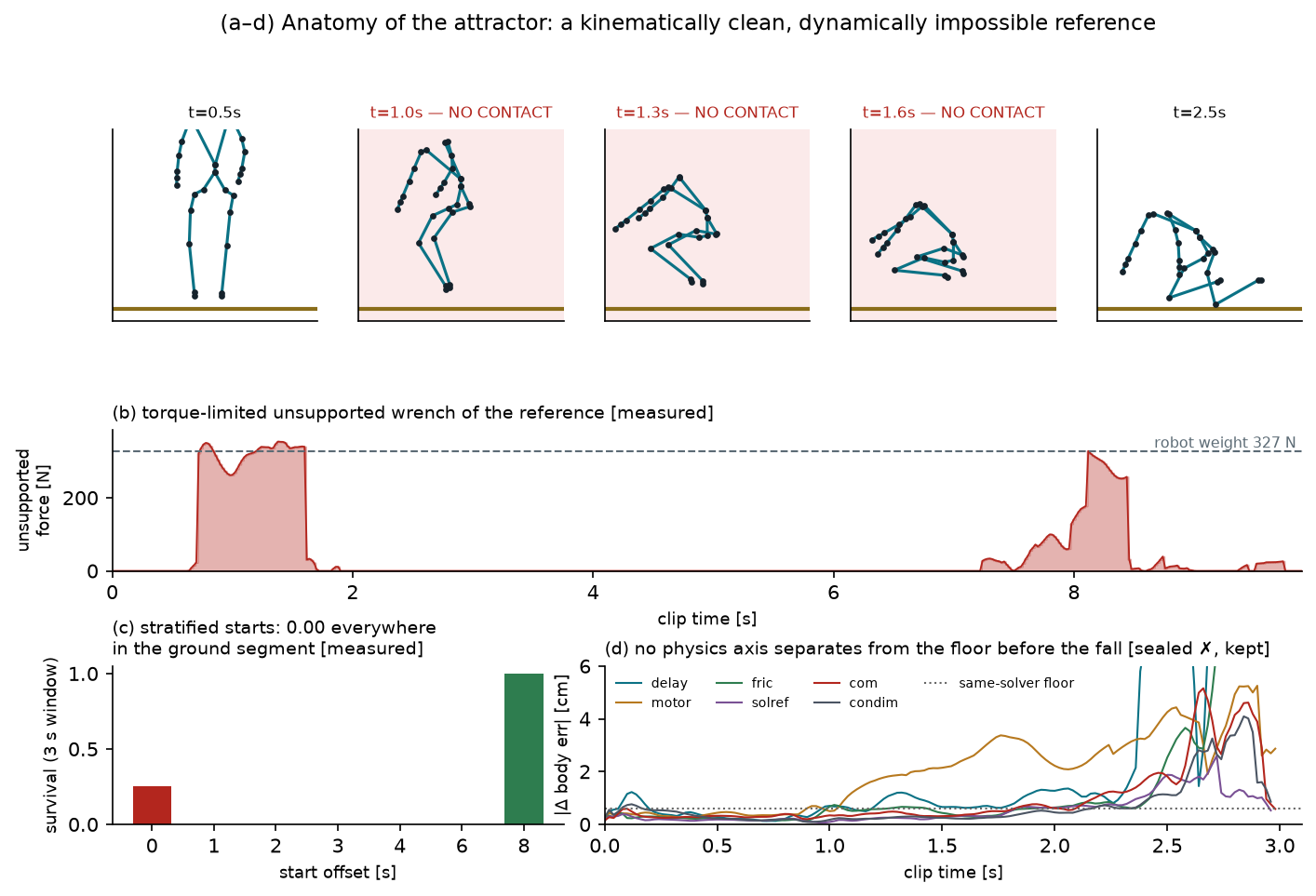
reports/N1_clip44_knee_id.json). The verdict is unambiguous: in the descent, 0.75–1.75 s, no
collision geom is within 6 cm of the floor — the retargeted feet float 7–10 cm up while the
pelvis falls 0.79 → 0.40 m — leaving ~329 N ≈ the robot's full weight (327 N) unsupported in 86 %
of those frames; the rise repeats it at 8.0–8.5 s. The kneel/crawl between is fully supportable
within actuator limits, even under the simulator's own frictionless-knee contact model. The
matched-easy control is supported at every frame. Kinematically the clip is ordinary — zero
joint-limit violations, ≤ 5.6 rad/s — which is exactly why kinematic QC and the kinematic half of
our atlas could not see it. Mechanism: the human sits back onto the heels; the robot's leg cannot
fold that far; the retarget resolves the conflict by lifting the legs instead of lowering the root.
Resolution. The attractor decomposes into (i) a physically impossible transition — a data
defect, family-wide: 20 of its 40 nearest kneel/crawl neighbours exceed the 10 %-infeasible-frame
threshold (reports/N3_candidate_feasibility.json; the "12/40" first reported in
plan/N1_RESULT.md was an informal stricter cut, corrected in plan/GLOBAL_EVAL_ADDENDUM.md) —
and (ii) a feasible skill (kneeling, crawling) occupying 3.2 % of the training bank's duration, on
which the policy was never trained. The failure-weighted sampler cannot distinguish "impossible"
from "hard" from "unseen"; it poured 87–89 % of its exposure into the one clip where those three
coincide. The earlier "0.31 survival" was itself an artifact of start-offset averaging — episodes
beginning after the ground segment survived — which is why every difficulty label from here on
uses the stratified-start protocol (§6). Adding feasible members of this family makes the
feasible phase trackable in both N3 keystone seeds, but also improves the invalid descent and
regresses the adaptive arm, so the frozen preflight stops an unqualified causal reading (§8).
N7's completed repair-versus-keep/prune intervention gives a positive deployed-reference contrast
but no raw-reference policy transfer and fails its sealed benefit/coverage rule (§8.2).
6. The feasibility screen at scale (compressed; method and full tables in the companion note)
Method. For each frame of a retargeted reference: (i) q, q̇ from the clip and q̈ by central
differences; (ii) contact-free inverse dynamics (MuJoCo mj_inverse, contacts disabled) → the
6-D base wrench W the environment must supply and the joint torques with no contact; (iii) candidate
contacts = collision geoms within 6 cm of the plane (mj_geomDistance, nearest point);
(iv) contact forces in pyramidal friction cones (μ 0.6, or frictionless non-foot geoms for the sim
model) that best explain W — an NNLS for the unconstrained residual and a torque-limited LP for the
smallest unsupported wrench achievable within actuator force ranges. Per-clip features: airborne
fraction (no candidate contact), infeasible fraction (torque-limited unsupported wrench > ½ weight),
unsupported impulse per weight, torque-infeasible fraction. ~1 s per clip on one CPU core.
#44. Standing (0–0.75 s): supported. Descent 0.75–1.75 s: no collision geom within 6 cm of the floor — the feet float 7–10 cm above it while the pelvis falls 0.79 → 0.40 m — leaving 329 N ≈ body weight (327 N) unsupported in 86 % of frames; the retargeted human sat back onto the heels, the G1's leg cannot fold that far, and the retarget lifted the whole leg. Kneel/crawl 1.75–7.25 s: fully supportable by shins, thighs, hands and feet within actuator limits, even with frictionless knees. Rise 8.0–8.5 s: airborne again (250–330 N). The policy's tracking error starts growing exactly at 0.75 s and every world dies at 2.2–3.0 s. Kinematically the clip is ordinary (no joint-limit violations, ≤ 5.6 rad/s), which is why the atlas's kinematic features could not see it.
Prevalence (10,705 clips, ~1 CPU-s each; reports/feasibility_all/prevalence_report.txt,
sentinel reports/feasibility_all/COMPLETED): 22.8 % of this AMASS→G1 bank exceeds 10 % dynamically
infeasible frames — ground-contact category 39 %, dynamic 59 %, locomotion 25 %, quiet 13 % —
and by source dataset the rate spans 0.1 % (GRAB) to 100 % (CNRS), Transitions 90 %, CMU 40 %.
A three-orders-of-magnitude spread across sources under one pipeline and one robot is a
source-corpus × pipeline property, not a difficulty gradient. Of the attractor's 40 nearest kneel/crawl
neighbours, 20 exceed the threshold; the KIT kneel_down_to_crawl clips sit at 3–8 %.
![Figure F4 [measured]](assets/f4_prevalence.png)
Cross-bank: the rate belongs to a corpus-and-pipeline pairing, not to retargeting as such
[measured; pre-registered; independent re-implementation]. 22.8 % is a measurement of one
pipeline. The same method — re-implemented independently against a different G1 model
(g1_29dof_rev_1_0.xml, sha 15a330f1…; μ 0.7 rather than 0.6, identical 6 cm gap and ½-weight
bound) — was run over all 4,950 clips of the BONES-SEED bank that trains SONIC [NVIDIA GEAR,
arXiv:2511.07820]: 7 clips (0.14 %) exceed 10 % infeasible frames, against 22.8 % here — a
factor of 160, and 0.09 % of duration against 27.4 %. The measurement was pre-registered with
its consequence pre-committed — a rate under 10 % descopes the planned SONIC training ablation —
and the ablation is descoped (P10, GR00T-WholeBodyControl/docs/prediction_register.md; screen
gear_sonic/research/hygiene/screen.py, 4,950 clips in 131.7 s wall on 8 CPU workers, 0 failures).
This is not "SONIC is clean and AMASS is broken". The class is present in the cleaner bank —
111 clips (2.24 %) exceed 10 % airborne frames, and five of the seven flagged clips are jumps —
four named for the 50 cm box they use, which is absent from the flat scene — a real defect that
passed both kinematic QC and a shipped release filter, though a different defect: a scene mismatch
whose fix is terrain or exclusion, not root projection (§8.2). What the contrast establishes is
methodological: infeasibility prevalence is a property of a particular corpus-and-pipeline
pairing and must be measured per corpus, never carried over. At 0.145 CPU-seconds per clip in
that implementation (0.84 ms per screened frame; ~1 CPU-s in ours), minutes per corpus, that
measurement is affordable as a standing release gate rather than a one-off audit. Caveat carried:
the two banks are different source corpora screened by two implementations of one method, with a
shipped release filter on one side only, so the comparison bounds generality rather than isolating
the retargeter — the controlled version (two retargeters, same source clips) remains parked (§10).
The same run is also the sharpest evidence that airborne and infeasible must remain separate
axes: seven kneeling_loop_* clips sit at airborne fraction 1.000 with infeasible fraction 0.000 —
feet 7–9 cm off the floor for the whole clip, weight carried on the knees, supportable at every
frame. A filter that read "airborne" as "broken" would delete exactly the rare ground-contact
behaviour these banks are short of (3.2 % of our training duration, §5.3).
Evaluation-set contamination. 29 of our own 100 held-out clips are flagged. They score 6.0–8.4 points below each policy's
all-clips aggregate (8.4–11.8 below its feasible stratum; reports/N_atlas_v21.json) and cannot
separate samplers (§4). Policy, sealed before any new
number existed (plan/GLOBAL_EVAL_ADDENDUM.md, a93a87a0…): primary endpoints on the
feasible-only stratum, all-clips secondary, infeasible-only descriptive; the threshold's
provenance (it predates the policy) is recorded in the seal. We do not swap the evaluation set
mid-project.
A second hygiene finding, and a null. Reference poses also carry hand–hip interpenetration
(> 1 cm on a median 13 % of frames; 53 % of clips exceed 10 %), so the self-collision penalty is
charged against accurate tracking. Sealed test P-TAX (plan/PREREGISTRATION_P_TAX.md,
7960057a…) asked whether this tax predicts difficulty beyond the feasibility flag: it does
not (heldout partial ρ −0.04 to −0.15, no positive CI excluding zero on any arm — sealed rule
0/3; plan/P_TAX_RESULT.md, reports/P_TAX_result.json). It remains a recommendation — audit
reward terms against the reference, not only the policy — and nothing more.
Consequence for the argument (details §5, readout §8). #44's reference still decomposes physically into an impossible transition and a feasible skill the bank scarcely contains, but N3 shows that this physical phase boundary is not a learning boundary: ground16 augmentation raises kneel/crawl survival to 0.750 in both seeds and unexpectedly raises descent survival to 1.000/0.688. Its adaptive arm regresses, triggering the preflight stop on an unqualified causal claim. N7 must therefore compare repair, keep, and prune directly rather than assume only repair can move the descent.
What hygiene costs, and what segment-level curation returns [measured]. Clip-level pruning is
the blunt instrument, and it is what our own sealed hygiene arm uses: on tier_800 the screen
flags 99 clips = 20.2 min of the bank's 152.4 min, so pruning discards 13.3 % of its duration.
Re-screening those 99 clips at segment resolution (tools/screen_segments.py over per-frame screen
output; 99 clips in 45 s wall on 6 nice'd CPU workers) shows most of that is feasible material.
With no reference lookahead — mjlab's tracking observation is the current anchor only, guard 0 s —
contiguous feasible segments recover 12.5 of the 20.2 min (61.7 %), 584 of 1,259 sampler bins
stay usable, and only 3 of 99 clips are lost end to end: 8.2 % of the bank handed back. Widen
the guard band to 1.0 s, which is what an observation carrying 10 × 0.1 s of future reference
requires, and recovery falls to 5.8 min (28.9 %), 305 bins, 26 of 99 clips lost — 3.8 % of the
bank. Identical screen, identical clips: the value of segment-level curation falls as the
policy's reference lookahead grows, which makes the guard band a property of the framework, not
of the data. Pruning is therefore a lower bound on what feasibility hygiene can buy, not its
ceiling — the other route is repair, and the legacy operator recovers 1,606 of the strict 2,442
flagged clips bank-wide (65.8%; the historical 2,443-row directory includes one feasible no-op
control; reports/dfrp_v0/census/summary.md; §8.2). Caveat: the 1.0 s minimum segment
length and the strict bin-eligibility rule (any severe frame disqualifies a bin) are choices, not
measurements, and the recovery figures are duration claims — no training arm has yet consumed
curated segments.
Exact repair qualification [unsealed measured implementation; no policy claim]. The legacy
65.8% census is a routing result, not a training-ready recovery rate. DFRP v1 therefore froze a
stratified panel of 26 flagged candidates plus four source-matched feasible controls and required
residual infeasibility ≤ 5%, root displacement ≤ 8 cm, joint-limit validity, contact-IK residual
≤ 10 mm, full-horizon-safe starts, and fail-closed hash binding among the source motion, repair,
sidecar, and unit table. 22/26 flagged repairs pass and 4/4 controls are byte-identical
no-ops; the resulting 26-clip view contains 36 exact units and 10,561 legal 50-step starts
(reports/dfrp_v1_exact_panel/iter1/result.json). Two candidates fail the residual-feasibility
gate and two fail IK qualification, demonstrating why those gates must remain separate. This
validates the artifact and runtime contract on the panel; it is not a bank-wide recovery estimate
or evidence that consuming repaired references improves a policy.
Deployment implication (measured in sim; hardware phenomenology predicted, labeled). Tracking
the airborne descent saturates zero actuators until support is lost, then pins ≥ 4/29 at ≥ 98 %
force range within 0.6 s in 8/8 replicates — exactly 5/29 in 7/8, mean 16.8 %
(reports/effort_sat_at_fall.json) — an unplanned ~0.3 m fall
onto wrists and knees at every attempt. G1 showed no physics parameter rescues the original
outcome [sealed ✗, kept], so the offline screen functions as a pre-deployment safety filter:
1 CPU-second per clip against impact retries, current-limit bursts, and wasted DR budget on
unfixable segments. P-SIGN rejects the proposed runtime complement [sealed ✗: 7/12 family,
4/12 clean controls, 2/7 localised], so gain response must not be used as an online
infeasibility detector.
7. Difficulty that transfers (complete except the E3 slot)
The question. A difficulty atlas is useful only if it describes the motion, not one training
run. Two policies rank held-out difficulty at ρ = 0.832 (reports/A3_atlas_transfer.json); a
reference-kinematics/dynamics atlas fit on one policy predicted the other at ρ = 0.567–0.579 —
below the pre-registered 0.6 bar (sealed criterion; outcome recorded as a miss). What closes the
gap?
Support alone does not (sealed prediction, null). Bank-relative support features (kNN distance
and duration-weighted density in atlas space, category mass) were pre-registered
(plan/N2_RESULT.md) with two claims: atlas residuals concentrate on low-support clips — holds,
ρ(|resid|, kNN) = +0.60 / +0.54 (exploratory-confirmed on both start protocols) — and transfer
lifts above 0.567 — null: +0.00 to +0.03, inside a 200-draw random-feature baseline
(reports/N2_atlas_support.json). Diagnosis, stated in advance of E3: with a single training
bank, support is collinear with the intrinsic coordinates; it becomes a distinct object only when
the bank changes. That is E3's sealed test (slot, §8).
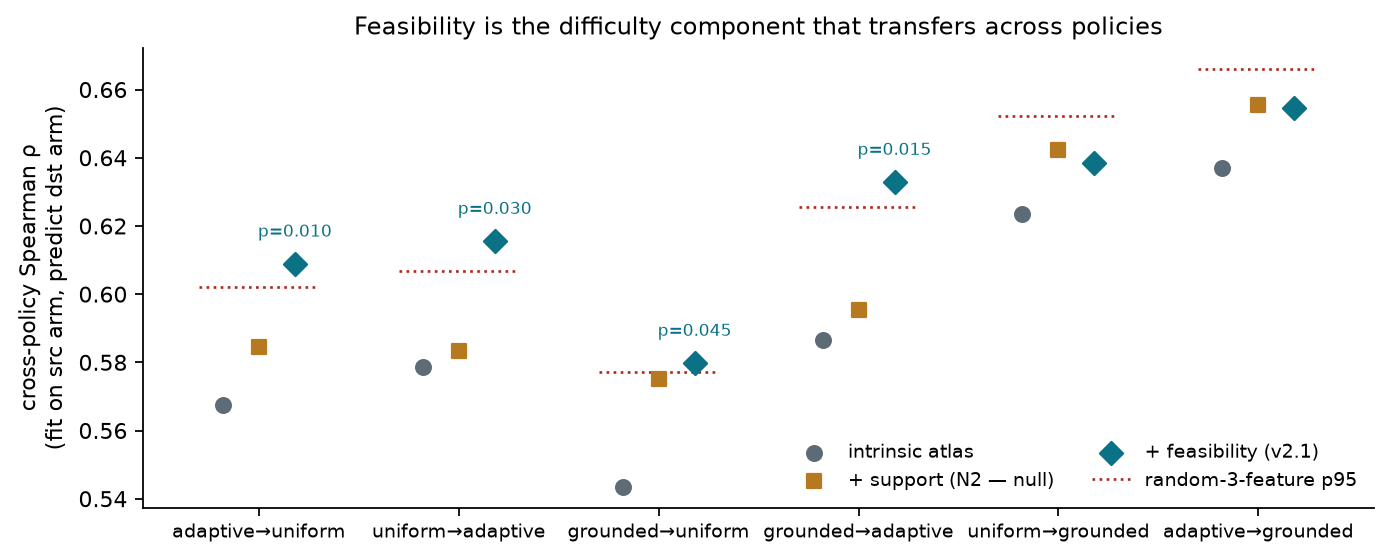
Feasibility does (sealed prediction, met). Atlas v2.1 added three screen features
(infeasible_frac, airborne_frac, unsupported impulse per weight), pre-registered
(plan/PREREGISTRATION_ATLAS_v21.md, 9b1a2c78…) with predicted transfer lift ≥ +0.03 at
permutation p < 0.05. Result (reports/N_atlas_v21.json, plan/ATLAS_v21_RESULT.md):
| transfer (A3 protocol) | intrinsic | + feasibility | random-3 p95 | perm p |
|---|---|---|---|---|
| adaptive → uniform | 0.567 | 0.609 | 0.602 | 0.010 |
| uniform → adaptive | 0.579 | 0.616 | 0.607 | 0.030 |
| grounded → uniform | 0.544 | 0.580 | 0.577 | 0.045 |
| grounded → adaptive | 0.586 | 0.633 | 0.626 | 0.015 |
| → grounded (2 pairs) | 0.623 / 0.637 | 0.638 / 0.655 | n.s. | 0.24 / 0.16 |
All six pairs move in the predicted direction; four clear the permutation baseline —
feasibility is the first feature family that transfers across policies, because it is a
property of the reference on the robot, not of any training run. Direct correlations:
ρ(held-out difficulty, infeasible_frac) = +0.37 / +0.48 / +0.50 per arm. The two companion
predictions were not met and are reported as sealed misses: within-bank LOO fit did not
improve (F1 — at 100 clips the screen features are collinear with the atlas's contact proxies,
which were their shadows all along), and the residual's correlation with infeasibility did not
vanish under a linear model (F3, half-met: support keeps explaining the misses).
Where this leaves the decomposition. Intrinsic features predict within-policy difficulty
(LOO ρ 0.47–0.51 training tier, 0.70+ on the original RQ1 protocol); feasibility adds the
cross-policy component; support is measured, predictive in the raw (ρ up to +0.41), and awaiting
its uncontaminated test. [E3 SLOT — sealed predictions 2c38845b…: per-clip Δdifficulty
(800−100) vs Δlog-support ρ ≤ −0.25; all 22 named dynamic held-out clips lose support and are
predicted to get harder; H2b-S support-moderation of the grounded−uniform gap; fills after the
Sept-15+ E3 run.]
8. Causal tests (one mixed result, three null mechanisms, one open test)
Everything before this section is observational or mechanistic. Four sealed training interventions and one unsealed wiring pilot have now read out. They do not support the broad conclusion that "feasibility intervention works" or that it does not. They support narrower diagnoses: N3 changes behaviour but trips its interpretation stop; E-HYG removes exposure the policy was not converting; soft FGAS fails its allocation gate; N7's benefit sits on the changed reference and its interaction with training; and the segment-v2 adaptive distribution is nearly its own uniform control. Thus no interpretable adaptive exact-segment allocation arm has yet run. That missing manipulation—not an assumed positive result—is the open causal test. Support moderation also remains open.
8.1 N3 — targeted composition [sealed mixed outcome]
Sealed 2026-08-19-era (plan/PREREGISTRATION_N3_coverage.md, af1b7c9f…; precondition
plan/N3_PRECONDITION_env_admits.md, 3c331e18… — terminations verified not to fire on the
reference; naive PD-follow shown uninformative; contact-supported dynamics verified). Design:
tier_mixed100 + ground16 (16 nearest feasibility-screened kneel/crawl neighbours) vs
+ random16; uniform ×2 seeds (keystone), adaptive ×1, random-control ×1; stratified-start
evaluation.
The frozen analyzer (b118b2d3…; reports/N3_result.json) records E1 and E4 as passes: #44's
feasible kneel/crawl-phase survival is 0.750 in both ground16 seeds, against base s1/s2/s3
0.000/0.031/0.188, while random16 remains 0.000. All three evaluated ground16 probes improve
in training. Its arithmetic decision E1∧E4 is therefore true.
The preflight also fixed a stop rule: do not interpret E1/E4 if E2 fails anywhere. It does in the
adaptive arm — heldout survival moves −0.0346 versus the three-seed base and one easy control
falls to 0.857. The two uniform keystone arms themselves do not regress (−0.0096/+0.0004), but we
retain the stricter global stop and call this a mixed outcome, not unqualified causal closure.
E3 also fails: maximum top-1 mass after iteration 2000 is 0.784 (needed <0.50). Most surprisingly,
the predicted unlearnable descent reaches 1.000/0.688, so composition changes tracking even over
the reference-invalid transition. N3 thus demonstrates a strong, specific training effect while
falsifying the clean phase-separation account (plan/N3_RESULT.md).
8.2 N7 — repair the impossible [sealed joint fail]
The repair-all arm completed at fixed N=800, clip names, ordering, sampler, seed, and compute
(reports/N7_result.json, plan/N7_RESULT.md). The 2×2 policy/reference cross gives a positive
deployment contrast: R/repaired minus K/raw is +0.0397, motion-bootstrap 95% CI
[+0.0153,+0.0658]. It nevertheless misses the sealed +0.05 smallest effect of interest. The
heldout point guard passes (−0.0104), but the zero-shot-ground coverage rule fails (R−K −0.0199;
R−P +0.0155, which needed +0.03), so the joint decision is false.
The cross localises the gain. R/raw minus K/raw is −0.0036, while K/repaired minus K/raw is +0.0233
and the policy-by-reference interaction is +0.0200. Thus −0.0036 + 0.0233 + 0.0200 = +0.0397:
there is no raw-reference policy transfer, but the repaired target is easier and the repair-trained
policy co-adapts to it. Post-outcome audit further shows that most gain comes from 11 repairs beyond
the 0.15 m distortion budget (+0.2305 mean versus +0.0160 on 78 certified repairs). Eight names in
heldout100 overlap tier800; the disjoint92 delta is −0.0122. These qualifications do not replace
the sealed result. They require reference-fidelity and paired motion-quality endpoints before
survival on a heavily altered target can be called better motion.
8.3 E-HYG — clip pruning at scale [sealed null]
The cheapest intervention — remove the 99 flagged clips from tier_800, hold training compute
fixed — does not improve performance (reports/E_HYG_result.json,
plan/E_HYG_RESULT.md). Feasible heldout survival moves 0.918→0.907 (Δ −0.0101, one-sided
permutation p=0.951; P1 needed +0.015), and the predicted worst-decile concentration is absent
(−0.0153 versus −0.0035 for the best half), so P1∧P2 fails. All-heldout Δ is −0.0132. Zero-shot
ground moves −0.0354, inside the pre-registered [−0.05,+0.02] coverage-cost bracket.
This one-seed null is specific to blunt clip pruning at 12.4% contamination. The removed clips are ones the comparator already fails on, so pruning removes exposure the policy was not converting; it does not create a distinct allocation over the feasible material that remains. It does not test the screen, repair, or bin-level eligibility. Together with the segment census, it sharpens the next method question: can masking infeasible bins retain coverage that pruning discards?
8.4 FGAS — clip-mean soft eligibility [sealed implementation-gate fail]
The three-seed soft guard-0 arm completed (reports/FGAS_result.json, plan/FGAS_RESULT.md). On
the frozen feasible-hard20 primary, survival moves 0.7586→0.7390 (Δ −0.0196, hierarchical
bootstrap 95% CI [−0.0497,+0.0134]), rather than the predicted gain of at least 0.05. Feasible
heldout moves −0.0123 and stays inside the −0.03 no-regression bound.
The implementation gate fails: late hard-rejected start mass is 0.199 (required <0.15), and the top clip is flagged in 0.861 of late iterations. Post-outcome reconstruction matches the live telemetry within 0.0022. Failure adaptation overwhelms the clip-mean soft multiplier; one clip with eligibility 0.702 retains 0.618/0.376/0.222 final mass across seeds. This is therefore a negative result for the implemented soft formulation, not a clean test of segment-native adaptive sampling: the intended treatment never controlled the realized allocation. A follow-up must make eligible segments the adaptive unit and be sealed separately.
8.5 Segment-v2 — exact mechanics, failed manipulation [exploratory; not tested]
The v2 runtime fixes the old sampler and evaluator mechanics: exact horizon-safe support, stable
unit attribution, explicit 50-step truncation, paired startup randomization, terminal reads before
reset, and zero invalid or censored trials (plan/SEGMENT_NATIVE_FOLLOWUP_2026-08-20.md). Its
one-seed, 42-unit wiring pilot moves paired success by +0.0079, with a unit-clustered 95% interval
[−0.0536,+0.0714] (reports/segment_v2_pilot/result.json). That outcome is not the load-bearing
readout. The load-bearing manipulation check is that the final adaptive allocation is only
0.014 total variation from its capped uniform control (correlation 0.998), because conditional
failure saturates near one across most units.
Accordingly, this pilot is a mechanical pass and an allocation fail. Calling its outcome a null for adaptive segment sampling would treat two nearly identical distributions as different treatments. The next arm must predeclare and pass an informative allocation band before outcome evaluation; until then, exact-feasible adaptive allocation is not tested.
8.6 E3 — support moderation at scale [SLOT]
Sealed (plan/PREREGISTRATION_E3_addendum.md f7929136… + v2 2c38845b… + the D1 policy
a93a87a0…): uniform-800 ×3 vs grounded-800 ×3 (+ ≤1 adaptive demo, optional LP arm);
bank-invariant support (clean-bank z-space, fixed kernel h = 2.00); bidirectional named
predictions — the 22 dynamic held-out clips all lose support 100→800 and are predicted to get
harder (P-A, the risky half); the 20 largest support gainers get easier (P-B); grounded's
advantage concentrates on the losers (P-D, H2b-S: ρ(Δᴳ⁻ᵁ, Δlog-support) ≤ −0.25). Feasible-only
primary endpoints per D1; bank composition (ground 3.2 % → 0.65 %, dynamic 11.8 % → 1.9 %) is an
analysed variable; feasibility flags are a launch gate (already computed for all 900 clips,
reports/feasibility_e3/feasibility.csv, sentinel present).
Fills: after N3 in the Sept-15+ GPU order; results freeze Dec 1.
9. A calibrated instrument for physics sensitivity
Why an instrument section exists. The G1 gate (§5.2) produced a methodological finding that outranks its negative: the natural fragility statistic — mean |φ⁺ − φ⁻| along paired single trajectories — is chaos-dominated. Two runs of identical physics from identical states (the conformance pair of §5.1) already diverge by 2.5–8.4 mm of body-position error within seconds; closed-loop humanoid tracking has a Lyapunov horizon of ~1–2 s at the millimetre scale. Every intervention effect in the pre-registered analysis (0.003–0.019 m) sat at that floor, which is why nothing could be reported under the sealed 5× rule. An instrument that folds the sign measures divergence, not mechanism.
The calibration (tools/analyze_g1_v2.py; reports/G1/run0/g1_v2_*; labelled instrument
calibration, not a re-adjudication of G1). Three replacements, each with the floor measured
identically from the stock-engine arm: S, the signed replicate-mean effect
E_r[mean_t(φ⁺ − φ⁻)] with paired-bootstrap CIs (chaos averages out; shrinks with R); D, the
Wasserstein-1 distance between pooled φ distributions minus the identical-physics W1; T,
paired timing statistics (first-termination shift, contact-onset shift). Resolution criterion:
|S| > 2× the floor CI half-width with the CI excluding zero.
What it resolves (R = 8): the floor drops to ≈ 0 ± 1 mm on long clips, and mechanism effects of 6–14 mm stand clear of it — motor strength on 5/6 clips, delay on the dynamic clips (+11.9 mm on the 99th-percentile-speed clip), while stiffness/CoM/condim sit at 2–3 mm and contact onsets never move (≤ 0.03 s under every intervention). Timing adds a phase channel: +20 ms of action delay brings the attractor's fall forward by 0.51 ± 0.14 s.
It replicates. An independent replicate set (IC seed 1, reports/G1/run1_seed1/): Pearson
r = 0.92 across the 36 (axis, clip) signed effects, and 6/6 sign agreement on every effect
above 5 mm; 2–4 mm effects flip sign exactly as their CIs permit (plan/N5_RESULT.md). The
instrument is reproducible where it claims resolution and says so where it does not.
The anomaly it certifies (exploratory, two supporting cases): on the impossible clip, +15 % motor strength makes tracking worse (+11.5 / +12.8 mm across seeds, CIs excluding zero) while helping every other clip (−2.6 to −14.2 mm). Windowed against the N1 contact flags, the reversal is absent while the reference is supportable (+0.3 / −1.4 mm), switches on in the airborne window (+15.0 / +16.0 mm), and persists into its aftermath. Reading: a stronger robot executes this untrackable reference harder.
P-SIGN rejects the general detector [sealed ✗, kept; c7916e8c…]. On 12 named infeasible
family clips, 7 (needed 8) show ≥ +5 mm airborne effects with CI > 0; only 2 of those 7 meet the
3× airborne/standing localisation rule. Just 4/12 feasible controls stay within the required
2 mm whole-clip bound. The joint rule fails (reports/P_SIGN/run0/p_sign_summary.json,
plan/P_SIGN_RESULT.md). The two #44 replications remain valid exploratory measurements, but
motor sensitivity is neither sufficiently general nor sufficiently specific to serve as a
rollout-only infeasibility detector or runtime guard.
10. Limitations and scope
One robot, one embodiment. Every number is Unitree G1. The screen's verdicts are embodiment-relative by construction (a clip infeasible for the G1's leg fold may be feasible for a robot with different limits); prevalence rates will differ per robot, though the 0.1–100 % per-source spread suggests the pipeline-property conclusion is robust.
One task configuration. One reward set (BeyondMimic-style tracking terms), one termination set, one PPO configuration, one action space (position targets at 50 Hz). The P-TAX null (§6) shows the reward's reference-interpenetration tax does not confound difficulty here; other reward configurations were not tested.
Survival-centric endpoints and evaluation audit. Difficulty = 1 − survival throughout.
Tracking-error endpoints correlate but were not sealed as primaries. Post-outcome review found that
the evaluators did not pair startup randomization, fixed-second offsets were clipped and duplicated
on short motions while missing late phases of long motions, and terminal error/effort reads followed
auto-reset. climb_eval.py also acts once on a stale pre-assignment observation. Survival remains a
measured endpoint under the sealed harness, but terminal motion-quality claims and fully paired
method deltas require the v2 evaluator (plan/SEGMENT_NATIVE_FOLLOWUP_2026-08-20.md).
Horizon. Exp-1/2 trained 4,000 iterations at 4,096 environments; the adaptive-vs-uniform gap could in principle close at much longer horizons (an E4 cell is sealed but unscheduled). Branch B ("grounded ≈ uniform" at 100 clips) is a bounded claim at this scale, not an asymptotic one.
Coverage versus exploration. Normalise-then-mix changes the realized exploration distribution as well as enforcing coverage, so grounded-versus-adaptive does not isolate a pure "coverage" mediator. The result establishes that the documented non-floor and collapse are avoidable at matched training compute; it does not assign the entire performance difference to the minimum probability mass alone. The exposure ledger is diagnostic, not a mediation analysis.
Simulation only. No hardware in this paper. The sign-reversal signature (§9) failed its sealed simulation generality/specificity test and is not proposed as a deployment-time diagnostic. The LUCID-correlation — whether our simulated exposure audit predicts a companion project's sim-to-real degradation — is the one bridge on the roadmap, and its N is small (few policies, few motions); we state that caveat wherever it is cited.
Causal work remains incomplete. N3's composition endpoints pass but its preflight stop fires; E-HYG's pruning arm is a sealed null; soft FGAS fails its implementation gate; N7 has a positive deployment contrast but fails its benefit and coverage rules; and the exploratory segment-v2 adaptive arm is only 0.014 TV from its control. E3 (support at scale) remains sealed and pending (§8). The decomposition's feasibility axis is causally closed through measurement (N1), prediction transfer (§7), and a bounded repair intervention, but no completed intervention yet improves policy skill on unchanged references under all of its registered guards. In particular, no adaptive exact-segment arm has both passed an allocation-manipulation check and reached confirmatory outcome evaluation.
Descoped: the solver-ensemble program. This project began with the hypothesis that disagreement across physics engines could serve as an uncertainty oracle for sim-to-real. We descoped it for three reasons, in order of discovery: (i) same-solver conformance consumed the error budget — four silent integration errors produced larger effects than any cross-solver difference we intended to measure, and until a harness passes per-substep conformance, cross-solver disagreement measures the harness; (ii) the fragility gate showed single-trajectory divergence is chaos-dominated at exactly the scales an ensemble would integrate over; (iii) the attractor that motivated the program dissolved into a data defect. The second engine earned a different role — referee (conformance), measurement backend (the batched inverse-dynamics/LP screen), and instrument floor (N5) — and we report that plainly rather than as the program originally imagined.
Bank provenance, and what the second bank does and does not settle. The bank-scale prevalence numbers are one retargeting pipeline's output (whole_body_tracking → G1). A second production bank — the 4,950-clip BONES-SEED corpus as consumed by SONIC — has since been screened by an independent re-implementation and comes in at 0.14 % (§6); that is what licenses the per-corpus framing and forecloses reading 22.8 % as a rate for retargeted banks generally. It is not the controlled comparison: different source corpus, different robot model file, different friction coefficient (μ 0.7 vs 0.6), and a release filter on one side only, so corpus content and the filter are confounded with the retargeter. The controlled version — two retargeters over the same source clips, one screen — remains parked, and until it is run the honest statement is that prevalence varies by orders of magnitude across pipelines, not that any named pipeline causes it. Claims about source mocap quality stay out of scope: the screen certifies the retargeted output on the target robot.
Plane-only terrain, made concrete. The screen assumes a flat floor, and the second bank shows what that costs: five of its seven flagged clips are jumps, four of them named for a 50 cm box that is not in the screened scene. Their references are unsupportable as screened and, if trained on a flat floor, unsupportable in fact — but the defect is a scene/reference mismatch whose fix is terrain or exclusion, and the repair operator (root projection) is the wrong tool for it. On terrain-bearing corpora the screen must be given the terrain, or its verdicts must be read as "unsupportable on a plane".
Exhibit: the sealed record (every pre-registration, hash, prediction, outcome)
All hashes sha256 (truncated); seal files in plan/, hash manifests in plan/*.sha256.
Outcomes: ✅ confirmed · ❌ refuted/null (as sealed) · ⚠ uninformative by registration defect ·
🕐 slot (sealed, not yet run) · ⬅ withdrawn.
| seal | hash | sealed | primary prediction | outcome | artifacts |
|---|---|---|---|---|---|
| A2 (Exp-2 grounded arm) | 37daa8a9 |
2026-08-16 | grounded beats/matches uniform on AULC; beats adaptive | ✅ grounded ≫ adaptive (AULC +0.055, 3/3 seeds); grounded ≈ uniform (Branch B, AULC −0.002) | plan/BRANCH_DECISION.md, reports/campaign_summary_3arm.json |
| A2 co-primary (iters-to-target) | 〃 | 〃 | grounded reaches uniform's endpoint sooner | ⚠ target was uniform's own rounded-up mean → uniform censored at its own bar; reported as uninformative, no compute-reduction claim | plan/BRANCH_DECISION.md |
| E10 (α/cap 2×2) | dc207877 |
2026-08-17 | (frozen before running) | 🕐 frozen per v4/v5 | plan/PREREGISTRATION_E10.md |
| S1 conformance verdict | — (result, not seal) | 2026-08-17 | Newton ≡ mjlab to seed noise | ⬅ initial "PASS with a contact-event fork that is itself a fragility measurement" withdrawn: the fork was four integration errors (#8–11); after fixes 1.000/1.000 vs 1.000/1.000 | plan/S1_RESULT.md (revised in place with the withdrawal recorded), reports/S1_*_absorb.json |
| G1 clip-#44 gate | 41e4b20c + addendum 2a9ceaca |
2026-08-17 | contact-model & CoM fragility ≥ 2× matched-easy, ≥ 5× same-solver floor, pre-failure localisation | ❌ gate fails as sealed: 1.30–1.33× on predicted axes; nothing reaches 5× floor; termination fragility zero everywhere | plan/G1_RESULT.md, reports/G1/run0/ |
| N2 support features | (in plan/N2_RESULT.md, pre-stated) |
2026-08-18 | residuals concentrate on low support ✚ transfer lifts above 0.567 | ✅ residuals (ρ +0.60/+0.54) / ❌ transfer (+0.00–0.03, inside noise baseline) — the honest split | reports/N2_atlas_support.json |
| N3 coverage causality | af1b7c9f (+ precondition 3c331e18) |
2026-08-18 | attractor kneel/crawl-phase survival 0.000 → ≥ 0.25 in 2/2 keystone seeds; random16 control < 0.10 | ⚠ E1/E4 pass (0.750/0.750; random 0.000), but adaptive E2 regression triggers the frozen preflight stop; E3 and descent predictions miss | reports/N3_result.json, plan/N3_RESULT.md |
| E3 addendum (support moderation) | f7929136 |
2026-08-18 | H2b → support-moderation; stratified starts; composition analysed | 🕐 post-Sept-15 | — |
| E3 addendum v2 (bidirectional, named) | 2c38845b |
2026-08-18 | 22 named dynamic clips get harder at 800; 20 named gainers easier; ρ(Δᴳ⁻ᵁ, Δsupport) ≤ −0.25 | 🕐 post-Sept-15 | reports/support_change_heldout100_100to800.csv |
| Atlas v2.1 feasibility features | 9b1a2c78 |
2026-08-18 | F1 within-bank lift ≥ +0.05 / F2 transfer lift ≥ +0.03 at p < 0.05 / F3 residual anatomy | ❌ F1 / ✅ F2 (0.567 → 0.609, p = 0.010; all six pairs positive) / half F3 | reports/N_atlas_v21.json, plan/ATLAS_v21_RESULT.md |
| D1 evaluation policy | a93a87a0 |
2026-08-19 | (policy, not prediction) feasible-only primary; threshold provenance cited | — sealed before N3 relaunch / any E3 number | plan/GLOBAL_EVAL_ADDENDUM.md |
| P-SIGN sign-reversal generality | c7916e8c |
2026-08-19 | ≥ 8/12 family clips ≥ +5 mm airborne (CI>0); ≥ 8/12 controls < 2 mm; ≥ 3× localisation | ❌ fails as sealed: 7/12 family, 4/12 controls, 2/7 localised; no runtime-detector claim | reports/P_SIGN/run0/p_sign_summary.json, plan/P_SIGN_RESULT.md |
| E-HYG pruning at scale | a5494b7c (analysis 5f8eb56e) |
2026-08-21 | feasible heldout Δ ≥ +0.015 with worst-decile concentration; ZS-ground in [−0.05,+0.02] | ❌ sealed null: Δ −0.0101, p=0.951; P2 fails; ground boundary upheld (−0.0354) | reports/E_HYG_result.json, plan/E_HYG_RESULT.md |
| P-TAX reward-tax relevance | 7960057a |
2026-08-19 | tax → difficulty partial CI > 0 on ≥ 2 heldout arms | ❌ null as sealed (0/3; significant CIs are negative) — hygiene finding only | plan/P_TAX_RESULT.md, reports/P_TAX_result.json |
| Research plan v5 | 4d490cf8 |
2026-08-19 | (directive encoding) | — | plan/RESEARCH_PLAN_v5.md |
| FGAS eligibility-masked sampling | 3521c80e |
2026-08-20 | feasible-hard20 Δ ≥ +0.05 with seed×motion bootstrap lower bound > 0; heldout Δ ≥ −0.03 | ❌ primary Δ −0.0196, CI [−0.0497,+0.0134]; no-regression passes, but rejected-start mass 0.199 fails the implementation gate | reports/FGAS_result.json, reports/FGAS_diagnosis.json, plan/FGAS_RESULT.md |
| N7 contact-projection repair | 90da8a08 |
2026-08-20 | R/repaired − K/raw ≥ +0.05 with motion-bootstrap lower bound > 0; heldout and coverage guards | ❌ +0.0397, CI [+0.0153,+0.0658], below SESOI; heldout point guard passes, coverage fails; overall false | plan/N7_DRAFT_repair.md, plan/N7_RESULT.md, reports/N7_result.json |
Also on the record without seals (results that changed course): the atlas transfer criterion miss
(ρ 0.567 < 0.6 sealed bar, reports/A3_atlas_transfer.json); the H4→H4-r sign correction and the
A2 target defect (plan/ADDENDUM_2026-08-16.md); the "0.31 survival" start-offset artifact and
the 12→20 family-count correction (plan/GLOBAL_EVAL_ADDENDUM.md).
Appendix A1. Same-solver conformance: the elimination protocol and four silent integration errors
We coupled Newton's SolverMuJoCo (MuJoCo-Warp 3.11.0) to mjlab's environment so that mjlab keeps
observations, the frozen policy, actions and terminations while Newton integrates the physics —
MuJoCo state ↔ MuJoCo state through solver.mjw_data, one Newton substep per mjlab sim.step().
Both sides run the same MuJoCo-Warp version, so the pre-registered prediction was agreement to seed
noise. Instead the mastered clip KIT_1226 read survival 0.44–0.72 on Newton against 1.00 on mjlab in
six runs, with the same mean tracking error (Δ ≤ 1 mm) and a fork at control step ~298.
Protocol. (i) A complete model diff of the two compiled MJWarp models — every opt.* field, the
contact pair-filter matrix (469 robot–robot + 33 ground pairs), joints, actuators, geometry.
(ii) Static and spinning bias-force comparison from identical (q, q̇). (iii) Per-substep paired
stepping: from identical (q, q̇, ctrl, warm-start) at every substep of the forking window, one step
in each engine, comparing q̈, constraint forces, contact counts. (iv) Contact-set diffs with
MuJoCo-C as a third referee stepping the same pre-state. (v) A shadow solver: mjlab's engine
stepping Newton's own trajectory substep by substep during a Newton-driven rollout.
Findings. Four integration errors, all silent, none physics:
1. mjlab's startup domain randomisation (torso CoM ±2.5/5/5 cm, foot μ 0.3–1.2) is written into
env.sim.wp_model after compile and never reaches the spec; Newton was integrating the nominal
robot — a 3.3 N·m base gravity-torque residual, visible only as a ~1 cm whole-body CoM shift.
Fix: mirror the DR-expanded fields by name and recompute derived constants (residual → 3e-6).
2. Newton's MJCF import rounds geometry through float32 transforms (geom quaternions 4e-7 off,
body positions 3e-7). MuJoCo includes a contact iff dist < 0, and a lightly loaded foot capsule
rests at dist ≈ 0: the offset decides whether a frictional contact exists. At every disagreeing
substep Newton carried exactly one extra ground–foot contact at dist −0.0; MuJoCo-C agreed with
mjlab to 1e-3 and with Newton not at all (0.05–3.3 rad/s). Fix: copy the reference's exact float32
geometry into Newton's model (0 mismatches over 300 steps × 8 worlds).
3. The motion command teleports the robot after reset() computed its observation; the first
action was a random kick.
4. The coupling was one-directional. KIT_1226 is a 6.0 s clip; step 299 is its wrap, where the
motion command teleports the robot onto a fresh reference by writing qpos/qvel into mjlab's sim.
mjlab's arm got teleported; Newton's arm had the write overwritten by its own physics one substep
later and chased a reference that had jumped. Auto-resets and push events write state the same
way. Fix: absorb any environment-side state write into the solver at the start of each substep.
After the fixes: KIT_1226 1.000/1.000 vs 1.000/1.000 (Δerr −0.5 mm), clip #44 0.000 vs 0.000 (Δerr +1 mm), per-substep |Δq̇| ≤ 3e-5 across the whole window, contact counts identical. The same-solver residual is what makes the fragility instrument of §5 (N5) interpretable, and the protocol is reusable: any second physics implementation coupled to an RL harness should be held to per-substep paired stepping with an independent referee, not to end-of-episode metrics, which matched throughout.
Appendix A2. Instrument calibration detail (N5)
All numbers: reports/G1/run0/g1_v2_summary.json, reports/G1/run1_seed1/g1_v2_summary.json,
plan/N5_RESULT.md. Labels as marked.
Why the folded statistic fails [measured]. Two integrations of identical physics from identical states (the §5.1-certified pair) diverge by 2.5–8.4 mm of body-position error within seconds — closed-loop tracking is chaotic with a ~1–2 s Lyapunov horizon at the millimetre scale. Mean |φ⁺ − φ⁻| along paired trajectories therefore measures divergence, not mechanism: every G1 intervention effect (3–19 mm) sat at that floor, which is why the sealed 5× rule reported nothing.
The three calibrated statistics. S = E_replicates[mean_t(φ⁺ − φ⁻)] with paired-bootstrap 95 % CIs (2,000 draws) — signed, so chaos cancels in expectation and shrinks with R; D = W1(pooled φ⁺, pooled φ⁻) − W1(identical-physics pair); T = paired first-termination shift and per-foot contact-onset shift. Resolution rule: |S| > 2× the floor CI half-width with the CI excluding zero.
Floor behaviour [measured]. With R = 8 the identical-physics floor is ≈ 0 ± 1 mm on long clips (−0.1 [−0.9, +0.5] on the attractor; +0.2 [−1.0, +1.5] on the easy control) — the unbiased noise reference every effect is read against, published per run.
Resolved effects [exploratory labels; two independent IC-seed sets]. Motor ±15 %: resolved on 5/6 clips, spanning −14.2 mm (helps, high-dynamic clip) to +11.5/+12.8 mm (hurts, the impossible clip — the sign reversal, airborne-window-localised in both sets: +15.0/+16.0 mm airborne vs +0.3/−1.4 mm standing). Delay +20 ms: resolved on the dynamic clips (+11.9/+9.8 mm) and advances the attractor's fall by 0.51 ± 0.14 s. Stiffness/CoM/condim: 2–3 mm class, mostly unresolved. Contact onsets move ≤ 0.03 s under every intervention — no intervention changes when feet land, only what happens after.
Replication [measured]. Across seed sets: Pearson r = 0.92 over all 36 (axis, clip) effects; 6/6 sign agreement on every effect above 5 mm; 2–4 mm effects flip sign exactly as their CIs permit. The instrument is reproducible where it claims resolution and says so where it does not.
What a future fragility design inherits. Signed replicate means, R ≥ 8, published per-run
floor, δ sized so target effects clear ~2 mm, and reference-derived (not rollout-derived) windows
for any localisation claim. P-SIGN used that exact configuration and failed its joint rule
[sealed ✗; reports/P_SIGN/run0/p_sign_summary.json], showing that calibration alone does not
make a mechanism-specific signature general or specific.
Appendix A3. Screen validation detail
Artifacts: reports/N1_clip44_knee_id.json, reports/N1_CMU76_knee_id.json,
reports/N1_gap_sensitivity.json, reports/upstream_drafts/CNRS_AUDIT.md,
reports/repair_census/summary.json. Labels as marked.
Internal controls [measured]. Within the attractor clip itself the screen's phases align with mechanics: standing and kneeling phases report 0 N torque-limited residual (the kneel even under the simulator's frictionless-knee contact model); only the transitions flag. The matched-easy control is supported at every frame (τ/limit p95 = 0.66). The synthetic hover demo (a standing pose translated upward) flags at exactly its constructed 45 %.
Parameter sensitivity [measured; found by adversarial review, reported as found]. The contact gap is a real choice with two failure modes: at 3 cm the feasible control itself flags 42 % (the bank carries a ~3 cm systematic stance-clearance offset from retarget ground alignment); at 10 cm the screen degenerates (airborne geometry is granted as contact and the attractor's descent reads 0 %). 6 cm sits between the failure modes — above the bank's clearance offset, below bridgeable distance. The ½-weight bound is insensitive (flag mass 15.1/13.1/12.5 % at 0.25/0.5/0.75× weight) because unsupported force concentrates near 1× weight. Flight is exempt by construction (free fall demands no support), verified on a jump clip whose ballistic phases do not flag while its floating preparation frames do.
External validation [measured]. (i) A deterministic severity-stratified 5+5 hand-check of the
extreme sources reproduces the clearance verdict from raw NPZ poses: CNRS is 5/5 ingest defects
on ordinary walks (median lowest-geometry clearance 5.1–9.7 cm); Transitions is mixed, 3/5 ingest
and 2/5 acrobatic content, with no scene-mismatch verdict in the ten-clip panel
(reports/feasibility_extremes/). (ii) The rollout-only sign-reversal localises to screen-flagged windows in two
independent seed sets without the rollouts ever seeing the screen. (iii) The repair census closes
the loop constructively: lowering the root exactly where the screen says support is missing
removes the flag in 1,606 of the strict 2,442 flagged clips (65.8%, residual ≤ 5 %; C4), is a no-op on feasible controls, and
is correctly refused by the over-repair budget on genuine ballistics — a screen that flagged
noise would not respond to a targeted geometric fix this way.
Cross-implementation validation [measured; §6]. The strongest external check is a second,
independently written implementation of the same method (different codebase, different G1 MJCF,
μ 0.7 rather than 0.6) applied to a different production bank. It returns 0.14 % of 4,950 clips
above the 10 %-infeasible threshold — a screen carrying a systematic bug, or one that conflated
flight with infeasibility, would not return near-zero on a bank that contains 111 clips above
10 % airborne frames and 7 kneeling_loop_* clips at airborne fraction 1.000 with infeasible
fraction 0.000. The same run is a discrimination test the method passes in the other direction:
those kneeling loops carry their weight on the knees and are supportable at every frame.
We then applied both implementations to each clip in a deterministic stratified 20+20 panel
[measured; reports/feasibility_xcheck/; selection seed 260826]. The adapters preserve the exact
29-joint name/order/axis layout; the implementations retain their production MJCF and μ settings.
Across all 40 clips, infeasible_frac ranks agree at Spearman ρ = 0.984 and airborne_frac
at ρ = 0.997. At the strict infeasible_frac > 0.10 rule, 39/40 verdicts agree (97.5 %,
κ = 0.948): 16 both flag, 23 neither, one SONIC-only, zero CLIMB-only. AMASS agrees 20/20;
BONES-SEED agrees 19/20. The sole threshold disagreement is burpee_002__A362_M (CLIMB 0.019,
SONIC 0.136). Because selection is stratified on the native verdict, this table validates
implementation agreement; it is not a prevalence estimator and does not remove the corpus/release-
filter confound in the 160× cross-bank contrast.
| bank | stratum | clip | CLIMB infeasible / airborne | SONIC infeasible / airborne | >.10 flag |
|---|---|---|---|---|---|
| BONES-SEED | flagged | burpee_002__A362_M |
0.019 / 0.004 | 0.136 / 0.177 | disagree |
| BONES-SEED | flagged | high_jump_R_003__A367_M |
0.124 / 0.219 | 0.138 / 0.219 | agree |
| BONES-SEED | flagged | jump_off_50cm_R_001__A415_M |
0.358 / 0.418 | 0.366 / 0.425 | agree |
| BONES-SEED | flagged | jump_off_front_50cm_001__A416_M |
0.324 / 0.486 | 0.353 / 0.493 | agree |
| BONES-SEED | flagged | jump_off_front_50cm_R_002__A416_M |
0.379 / 0.426 | 0.379 / 0.426 | agree |
| BONES-SEED | flagged | jump_on_50cm_002__A415 |
0.636 / 0.721 | 0.658 / 0.721 | agree |
| BONES-SEED | flagged | kick_back_001__A495_M |
0.472 / 0.079 | 0.472 / 0.082 | agree |
| BONES-SEED | feasible | door_knob_right_side_open_R_001__A509_M |
0.000 / 0.000 | 0.000 / 0.000 | agree |
| BONES-SEED | feasible | greetings_hat_R_003__A261 |
0.000 / 0.000 | 0.000 / 0.000 | agree |
| BONES-SEED | feasible | injured_R_leg_idle_right_R_002__A326 |
0.000 / 0.000 | 0.000 / 0.000 | agree |
| BONES-SEED | feasible | jog_avoid_bump_270_R_002__A167 |
0.000 / 0.013 | 0.000 / 0.013 | agree |
| BONES-SEED | feasible | jog_ff_stop_360_R_002__A237_M |
0.011 / 0.000 | 0.000 / 0.000 | agree |
| BONES-SEED | feasible | jump_ff_360_R_003__A295 |
0.000 / 0.000 | 0.000 / 0.000 | agree |
| BONES-SEED | feasible | medium_big_heavy_one_hand_walk_ff_start_270_R_003__A505_M |
0.000 / 0.000 | 0.000 / 0.000 | agree |
| BONES-SEED | feasible | praying_001__A185_M |
0.000 / 0.000 | 0.000 / 0.000 | agree |
| BONES-SEED | feasible | reach_jump_R_003__A223 |
0.000 / 0.086 | 0.000 / 0.086 | agree |
| BONES-SEED | feasible | turn_jump_270_003__A058 |
0.000 / 0.000 | 0.000 / 0.000 | agree |
| BONES-SEED | feasible | walk_backward_stop_002__A037_M |
0.000 / 0.000 | 0.000 / 0.000 | agree |
| BONES-SEED | feasible | walk_sideway_135_start_001__A024 |
0.000 / 0.000 | 0.000 / 0.000 | agree |
| BONES-SEED | feasible | warm_welcome_R_001__A432_M |
0.000 / 0.000 | 0.000 / 0.000 | agree |
| AMASS-wbt-G1 | flagged | BMLmovi_Subject_53_F_MoSh_Subject_53_F_17_poses_120_jpos |
0.607 / 0.607 | 0.603 / 0.603 | agree |
| AMASS-wbt-G1 | flagged | BMLmovi_Subject_64_F_MoSh_Subject_64_F_9_poses_120_jpos |
0.130 / 0.124 | 0.134 / 0.228 | agree |
| AMASS-wbt-G1 | flagged | CMU_02_02_02_poses_120_jpos |
0.427 / 0.411 | 0.460 / 0.444 | agree |
| AMASS-wbt-G1 | flagged | CMU_102_102_28_poses_120_jpos |
0.669 / 0.795 | 0.669 / 0.792 | agree |
| AMASS-wbt-G1 | flagged | CMU_91_91_41_poses_120_jpos |
0.195 / 0.286 | 0.200 / 0.286 | agree |
| AMASS-wbt-G1 | flagged | CNRS_288_-12_L_1 |
0.648 / 0.629 | 0.634 / 0.618 | agree |
| AMASS-wbt-G1 | flagged | KIT_3_downstairs03_poses_100_jpos |
0.730 / 0.730 | 0.730 / 0.730 | agree |
| AMASS-wbt-G1 | flagged | KIT_3_kneel_up_hold03_poses_100_jpos |
0.319 / 0.319 | 0.319 / 0.319 | agree |
| AMASS-wbt-G1 | flagged | KIT_572_squat02_poses_100_jpos |
0.185 / 0.185 | 0.185 / 0.185 | agree |
| AMASS-wbt-G1 | flagged | KIT_675_walk_with_handrail_beam_right06_poses_100_jpos |
0.475 / 0.475 | 0.471 / 0.471 | agree |
| AMASS-wbt-G1 | feasible | BMLmovi_Subject_22_F_MoSh_Subject_22_F_2_poses_120_jpos |
0.000 / 0.000 | 0.000 / 0.000 | agree |
| AMASS-wbt-G1 | feasible | CMU_28_28_15_poses_120_jpos |
0.000 / 0.000 | 0.000 / 0.000 | agree |
| AMASS-wbt-G1 | feasible | Eyes_Japan_Dataset_hamada_throw_toss-05-both_hands_over_heavy-hamada_poses_120_jpos |
0.000 / 0.000 | 0.000 / 0.000 | agree |
| AMASS-wbt-G1 | feasible | Eyes_Japan_Dataset_shiono_gesture_etc-35-west_side-shiono_poses_120_jpos |
0.002 / 0.002 | 0.001 / 0.001 | agree |
| AMASS-wbt-G1 | feasible | GRAB_s8_gamecontroller_pick_all |
0.000 / 0.000 | 0.000 / 0.000 | agree |
| AMASS-wbt-G1 | feasible | KIT_291_push_recovery_stand_back03_poses_100_jpos |
0.000 / 0.000 | 0.000 / 0.000 | agree |
| AMASS-wbt-G1 | feasible | KIT_424_bend_left07_poses_100_jpos |
0.000 / 0.000 | 0.000 / 0.000 | agree |
| AMASS-wbt-G1 | feasible | KIT_4_WalkInCounterClockwiseCircle02_poses_100_jpos |
0.000 / 0.000 | 0.000 / 0.000 | agree |
| AMASS-wbt-G1 | feasible | KIT_7_RightTurn03_poses_100_jpos |
0.000 / 0.000 | 0.000 / 0.000 | agree |
| AMASS-wbt-G1 | feasible | KIT_9_bend_left08_poses_100_jpos |
0.000 / 0.000 | 0.000 / 0.000 | agree |
Known limits. Plane-only terrain — and the second bank makes the cost concrete: its flagged box jumps (four of its seven flagged clips) are unsupportable only because the 50 cm box they use is absent from the screened scene (a scene/reference mismatch, not a retarget defect, and not repairable by root projection). Embodiment-relative verdicts; q̈ from smoothed central differences (5-frame) — velocity-spike artifacts (one observed 40 rad/s glitch) are a separate QC class the screen does not target.