The next step
The planner knows where to go. The tracker decides whether the body gets there.
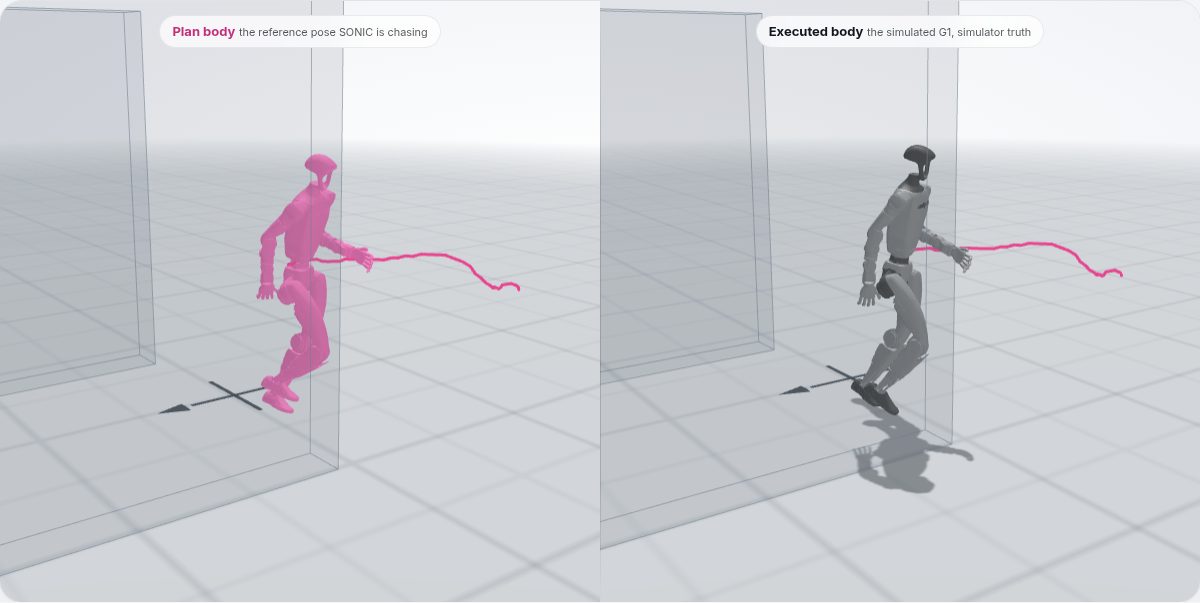
The deploy stack plans a whole-body motion and hands it to a tracking policy, SONIC, that turns it into motor targets. Studio records both: the plan body, the pose SONIC is chasing, and the body the simulated G1 executed. Everything on this page is measured by Studio in its own recordings.
Take a closer look · the execution gap
One plan. The body that followed it.
Left, the plan body; right, the executed body, in step. Each half follows its own pelvis, so the posture compares without the lag. Switch to overlay to see the lag.
Why it matters
Three numbers from Studio's recordings.
Walking frames at 25 Hz from every recorded walk; simulation, one seed per goal.
One plan. Two trackers.
The same plan stream, another tracker, scenario by scenario.
Studio is adding a tracker axis to its rehearsals: the recorded plan stream sent to a different tracker and scored the same way. The table fills in when one is run; until then only SONIC's column is measured.
SONIC: the deploy stack's tracking policy, in these recordings.
Method
How these are measured.
- Plan body and plan to body. The plan body is the reference SONIC is tracking at each 20 ms tick (row 0 of its reference window): 29 joint angles and an orientation, recorded by Studio's simulated robot and kept at 25 Hz. Its pelvis position is the planner's diagnostic; SONIC never receives it. Plan to body is the distance between that pelvis and the robot's own estimate of its pelvis, both in the planner's frame, over walking frames.
- Joint gap. Root-mean-square difference over the 29 joint angles between the plan body and the executed body, per walking frame.
- Contact. Peak obstacle contact force over 100 N at any frame of the walk, simulator truth.
- Simulation. CPU MuJoCo, planner budget 16 candidates and 10 ODE steps, 160 ms planner latency with predictive anchoring, LIO-level odometry drift, one memory per session, the current G1 actuator limits, seed 0. Not a hardware result.