Linji (Joey) Wang
AI Robotics Engineer · Automatic Curriculum Learning · Deep RL · Embodied Agents

RobotiXX Lab
George Mason University
Fairfax, VA 22030
I build adaptive training systems that decide what an embodied agent should practice next, how its rewards should change, and when it is ready for harder simulation conditions.
I am a Computer Science Ph.D. researcher at George Mason University's RobotiXX Lab, advised by Xuesu Xiao. My work spans automatic curriculum learning, deep reinforcement learning, GPU-parallel robot simulation, physical off-road validation, and ongoing humanoid policy inference.
Make training adapt to the learner.
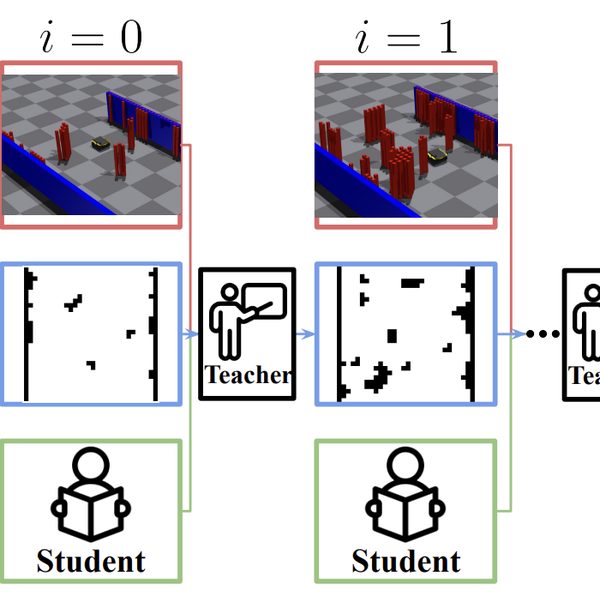
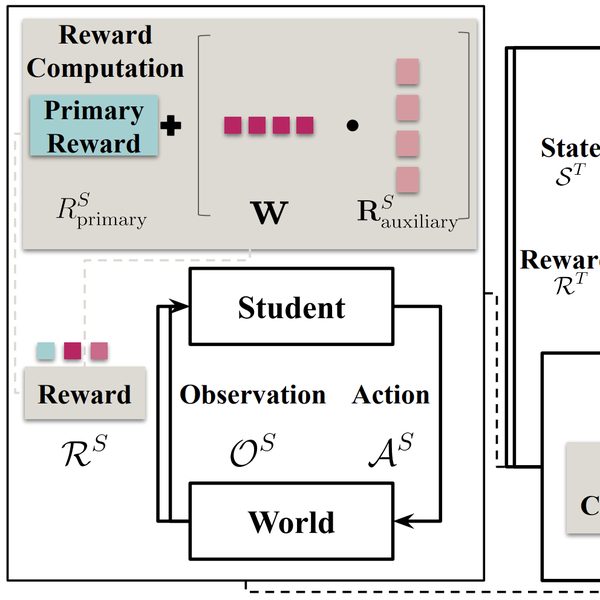
GACL adapts tasks. Reward Training Wheels adapts auxiliary rewards. LUCID paces domain randomization. These complementary methods share a research principle: understand the student, then adapt its training. Explore the interactive story →
GACL
Designed a grounded automatic curriculum framework using task representations, online performance history, and limited target-distribution samples.
Simulation vs CLUTR: +5.18 / +4.56 percentage pointsReward Training Wheels
Co-developed proficiency-conditioned auxiliary-reward adaptation for robot RL.
Simulation: 3× faster to threshold · Physical: 5/5 vs 2/5LUCID
Execution-informed domain-randomization curricula for humanoid motion tracking, using a frozen temporal encoder and bounded feedback control.
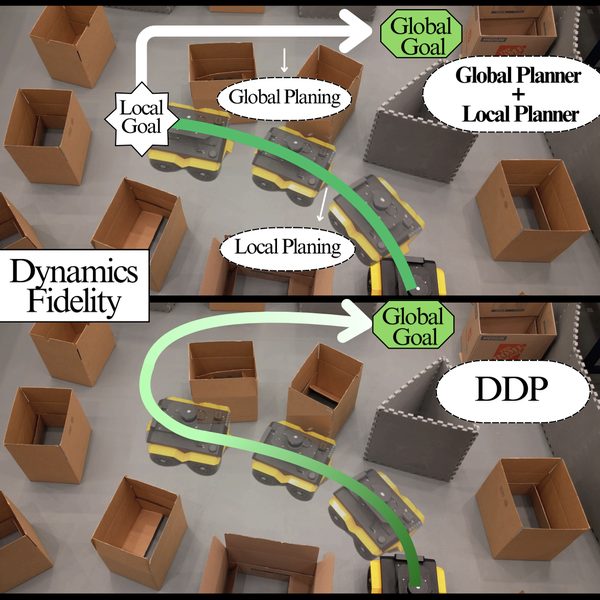
G1 study at +40 ms added delay: 38/60 vs 23/60 completionsResearch + systems engineering. I am also third author on Moving Through Clutter, a humanoid data and benchmarking study with 348 trajectories across 145 scenes, and I am developing a separate C++/ROS 2/ONNX policy-inference prototype. I also co-authored RL-based Adaptive Dynamics Planning (4th author, ICRA 2026) and DDP (3rd author, IROS 2025); the DDP-based RobotiXX system placed 2nd in both phases of the 2025 BARN Challenge. At AWS, I worked in C on PostgreSQL-based database internals, join processing, performance, and compatibility for Amazon Aurora PostgreSQL in summer 2026, after building statistical performance-testing infrastructure for RDS Proxy in summer 2025. Before my Ph.D., I completed an M.S. in Mechanical Engineering at Carnegie Mellon (GPA 3.94/4.0), working on 3D perception and AR scene inpainting, and a magna cum laude B.S. from the University of Cincinnati.
selected publications
news
| Sep 10, 2026 | The KimoNav research notebook now opens with a recorded side-by-side replay of the two simulated tasks the reference governor rescues, a drawn pipeline figure separating the frozen ARDY and SONIC models from our own stages, and the ceiling and tracker-floor results that bound how far reference repair can go. All execution is simulation. |
|---|---|
| Sep 06, 2026 | The KimoNav research notebook now follows the path from motion priors to navigation executed in physics simulation: Kimodo/ARDY/SONIC explained, candidate-execution results, and a bounded-response prediction study with its failed promotion gate retained. No hardware is involved. |
| Sep 05, 2026 | New KimoNav research notebook: generated humanoid motion, matched adapter experiments, interactive performance charts, and the limits of our current offline results. |
| Aug 31, 2026 | Spent summer 2026 working on Amazon Aurora PostgreSQL at AWS as a Software Development Engineer Intern, developing in C within the PostgreSQL-based database engine and contributing to Adaptive Join, an effort designed to improve join-processing performance adaptively. |
| Jun 02, 2026 | Adaptive Dynamics Planning, our learning-augmented framework for adapting robot dynamics fidelity to environmental complexity, appeared at ICRA 2026. |