Recent humanoid locomotion systems demonstrate dynamic behaviors primarily in open, obstacle-free settings, while homes and workplaces require scene-aware whole-body coordination in dense three-dimensional clutter. Moving Through Clutter (MTC) is an open-source virtual-reality data collection and evaluation framework that procedurally generates scenes, captures embodiment-consistent whole-body motion, and automatically retargets that motion to a humanoid model. The resulting dataset contains 348 trajectories across 145 diverse cluttered scenes, together with benchmarks for clutter, stability, and collision safety.
@article{wang2026moving,title={Moving Through Clutter: Scaling Data Collection and Benchmarking for 3D Scene-Aware Humanoid Locomotion via Virtual Reality},author={Wang, Beichen and Lu, Yuanjie and Wang, Linji and Yu, Liuchuan and Xiao, Xuesu},journal={arXiv preprint arXiv:2603.05993},year={2026},}
Autonomous navigation systems commonly separate dynamics-free global planning from dynamics-aware local control, which can cause tracking failures in constrained environments. Adaptive Dynamics Planning (ADP) uses reinforcement learning to adjust dynamics fidelity from current environmental observations, allocating modeling effort where it is most useful. Across three augmented planners and a standalone system, experiments in simulation and on a physical robot show consistent improvements in navigation success, safety, and efficiency.
@inproceedings{lu2026adaptive,title={Adaptive Dynamics Planning for Robot Navigation},author={Lu, Yuanjie and Mao, Mingyang and Xu, Tong and Wang, Linji and Lin, Xiaomin and Xiao, Xuesu},booktitle={2026 IEEE International Conference on Robotics and Automation (ICRA)},year={2026},}
Visual-inertial odometry estimates robot poses at high frequency but accumulates drift over time. ColorMap-VIO localizes against a prior colored point cloud using gradient-aware map sparsification and image-pyramid visual-photometric filtering, bounding drift by map precision while improving efficiency and robustness over existing map-based approaches.
@article{xu2026colormap,title={{ColorMap-VIO}: A Drift-Free Visual-Inertial Odometry in a Prior Colored Point Cloud Map},author={Xu, Jie and Zhang, Xuanxuan and Ma, Yongxin and Li, Yixuan and Wang, Linji and Xu, Xinhang and Yuan, Shenghai and Xie, Lihua},journal={IEEE Robotics and Automation Letters},volume={11},number={2},pages={1570--1577},year={2026},doi={10.1109/LRA.2025.3643289},}
Curriculum learning has emerged as a promising approach for training complex robotics tasks, yet current applications predominantly rely on manually designed curricula, which demand significant engineering effort and can suffer from subjective and suboptimal human design choices. While automated curriculum learning has shown success in simple domains like grid worlds and games where task distributions can be easily specified, robotics tasks present unique challenges: they require handling complex task spaces while maintaining relevance to target domain distributions that are only partially known through limited samples. To this end, we propose Grounded Adaptive Curriculum Learning, a framework specifically designed for robotics curriculum learning with three key innovations: (1) a task representation that consistently handles complex robot task design, (2) an active performance tracking mechanism that allows adaptive curriculum generation appropriate for the robot’s current capabilities, and (3) a grounding approach that maintains target domain relevance through alternating sampling between reference and synthetic tasks. We validate GACL on wheeled navigation in constrained environments and quadruped locomotion in challenging 3D confined spaces, achieving 6.8% and 6.1% higher success rates, respectively, than state-of-the-art methods in each domain.
@inproceedings{wang2025gacl,title={GACL: Grounded Adaptive Curriculum Learning with Active Task and Performance Monitoring},author={Wang, Linji and Xu, Zifan and Stone, Peter and Xiao, Xuesu},booktitle={2025 IEEE/RSJ International Conference on Intelligent Robots and Systems (IROS)},year={2025},pages={591--596},doi={10.1109/IROS60139.2025.11246910},}
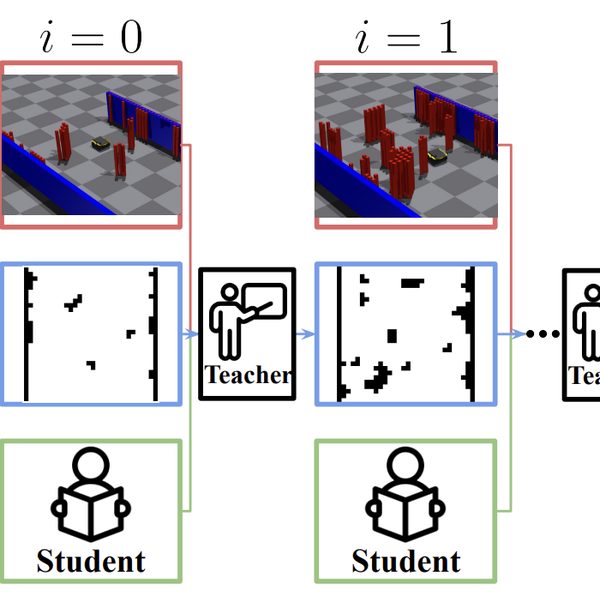
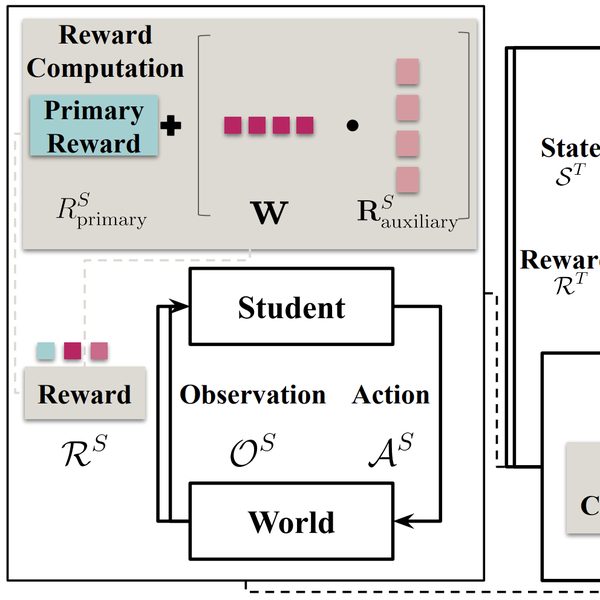
Robotics Reinforcement Learning (RL) often relies on carefully engineered auxiliary rewards to supplement sparse primary learning objectives to compensate for the lack of large-scale, real-world, trial-and-error data. While these auxiliary rewards accelerate learning, they require significant engineering effort, may introduce human biases, and cannot adapt to the robot’s evolving capabilities during training. In this paper, we introduce Reward Training Wheels (RTW), a teacher-student framework that automates auxiliary reward adaptation for robotics RL. To be specific, the RTW teacher dynamically adjusts auxiliary reward weights based on the student’s evolving capabilities to determine which auxiliary reward aspects require more or less emphasis to improve the primary objective. We demonstrate RTW on two challenging robot tasks: navigation in highly constrained spaces and off-road vehicle mobility on vertically challenging terrain. In simulation, RTW outperforms expert-designed rewards by 2.35% in navigation success rate and improves off-road mobility performance by 122.62%, while achieving 35% and 3X faster training efficiency, respectively. Physical robot experiments further validate RTW’s effectiveness, achieving a perfect success rate (5/5 trials vs. 2/5 for expert-designed rewards) and improving vehicle stability with up to 47.4% reduction in orientation angles.
@inproceedings{wang2025reward,title={Reward Training Wheels: Adaptive Auxiliary Rewards for Robotics Reinforcement Learning},author={Wang, Linji and Xu, Tong and Lu, Yuanjie and Xiao, Xuesu},booktitle={2025 IEEE/RSJ International Conference on Intelligent Robots and Systems (IROS)},year={2025},pages={15262--15267},doi={10.1109/IROS60139.2025.11247039},}
The RobotiXX navigation system placed second in both the simulation qualifier and physical finals of the 2025 BARN Challenge at ICRA 2025.
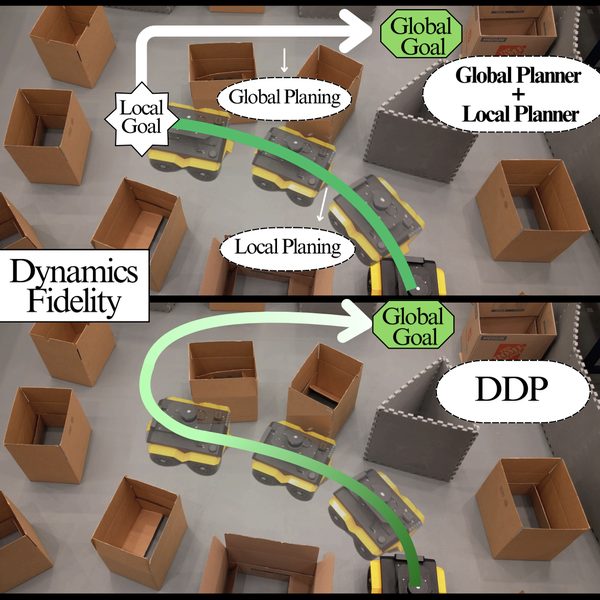
Most robot navigation systems separate dynamics-free global planning from dynamics-aware local planning, which can create infeasible paths in constrained environments. Decremental Dynamics Planning (DDP) integrates dynamics across the planning horizon, using high-fidelity modeling near the robot and progressively simplifying it farther away. DDP improved planning performance overall when applied to three planners, and the resulting navigation system placed second in both the simulation and real-world phases of the 2025 BARN Challenge.
@inproceedings{lu2025decremental,title={Decremental Dynamics Planning for Robot Navigation},author={Lu, Yuanjie and Xu, Tong and Wang, Linji and Hawes, Nick and Xiao, Xuesu},booktitle={2025 IEEE/RSJ International Conference on Intelligent Robots and Systems (IROS)},year={2025},pages={4559--4565},doi={10.1109/IROS60139.2025.11246580},}
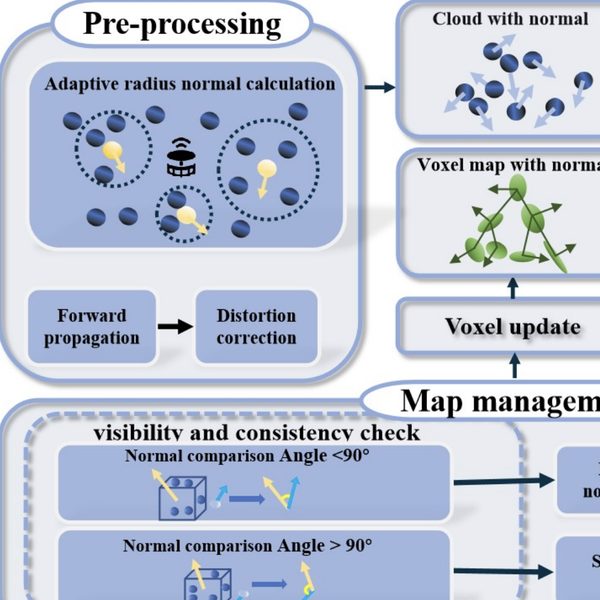
SLAM technology plays a crucial role in indoor mapping and localization. A common challenge in indoor environments is the "double-sided mapping issue", where closely positioned walls, doors, and other surfaces are mistakenly identified as a single plane, significantly hindering map accuracy and consistency. To address this issue, this letter introduces a novel approach that leverages normal vector consistency to enhance map accuracy and consistency, integrating normal vector information into the mapping and localization process.
@article{zhao2025ii,title={II-NVM: Enhancing Map Accuracy and Consistency with Normal Vector-Assisted Mapping},author={Zhao, Chengwei and Li, Yixuan and Jian, Yina and Xu, Jie and Wang, Linji and Ma, Yongxin and Jin, Xinglai},journal={IEEE Robotics and Automation Letters},year={2025},volume={10},number={6},pages={5465--5472},doi={10.1109/LRA.2025.3561568},}