Robot navigation that plans with full dynamics only where it matters — 2nd place in both phases of the 2025 BARN Challenge
Overview
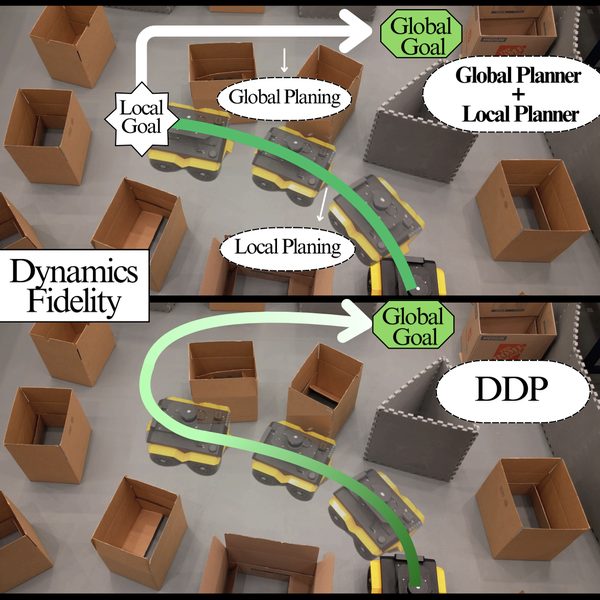
Most navigation planners either pay the full computational cost of planning with complete robot dynamics everywhere, or ignore dynamics and suffer in difficult terrain. Decremental Dynamics Planning (DDP) (Lu et al., 2025) starts planning with full dynamics near the robot — where fidelity matters most — and progressively simplifies the dynamics model along the horizon, spending compute where it buys the most safety and performance.
Top: a conventional global + local planner. Bottom: DDP plans one trajectory with dynamics fidelity that decreases along the horizon.
My contribution
This is a collaboration led by my labmate Yuanjie Lu (with Tong Xu, Nick Hawes of Oxford, and our advisor Xuesu Xiao); I am third author.
Published results
Augmenting three different existing planners with DDP improved planning performance overall.
The DDP-based RobotiXX navigation system placed 2nd in both the simulation qualifier and physical finals of the 2025 BARN Challenge (Benchmark Autonomous Robot Navigation).
Paper
Y. Lu, T. Xu, L. Wang, N. Hawes, X. Xiao. “Decremental Dynamics Planning for Robot Navigation,” IROS 2025. arXiv
The RobotiXX navigation system placed second in both the simulation qualifier and physical finals of the 2025 BARN Challenge at ICRA 2025.
Most robot navigation systems separate dynamics-free global planning from dynamics-aware local planning, which can create infeasible paths in constrained environments. Decremental Dynamics Planning (DDP) integrates dynamics across the planning horizon, using high-fidelity modeling near the robot and progressively simplifying it farther away. DDP improved planning performance overall when applied to three planners, and the resulting navigation system placed second in both the simulation and real-world phases of the 2025 BARN Challenge.
@inproceedings{lu2025decremental,title={Decremental Dynamics Planning for Robot Navigation},author={Lu, Yuanjie and Xu, Tong and Wang, Linji and Hawes, Nick and Xiao, Xuesu},booktitle={2025 IEEE/RSJ International Conference on Intelligent Robots and Systems (IROS)},year={2025},pages={4559--4565},doi={10.1109/IROS60139.2025.11246580},}